Physical Address
304 North Cardinal St.
Dorchester Center, MA 02124
Physical Address
304 North Cardinal St.
Dorchester Center, MA 02124

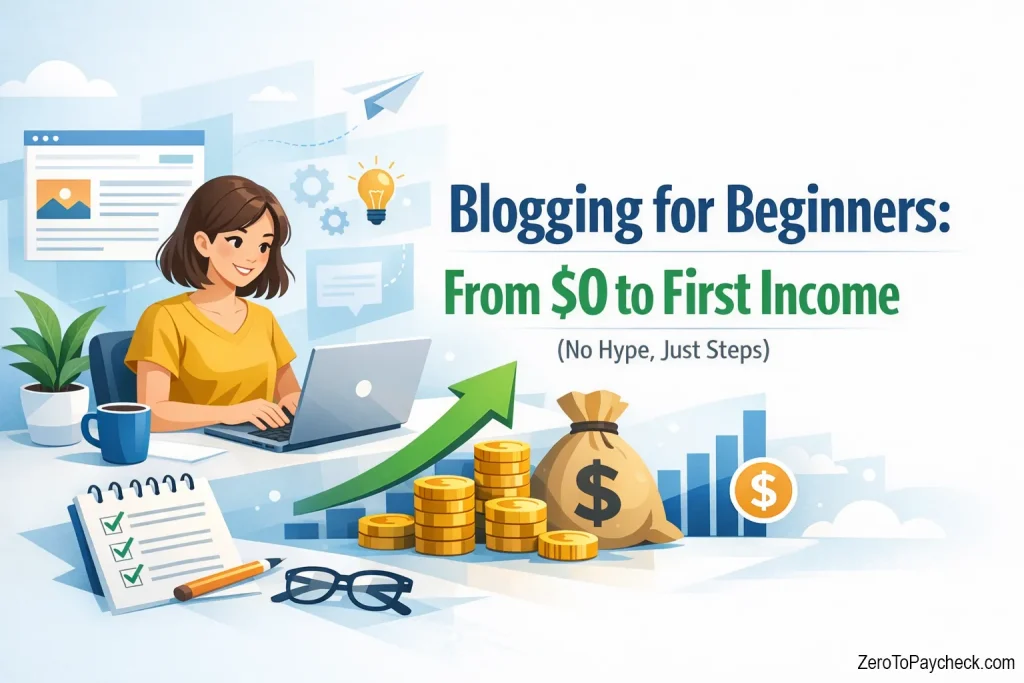
A Step-by-Step Tutorial for the Skeptical Beginner
Let me guess. You found this article sometime between midnight and 2 a.m., in a tab buried beneath seven other tabs, half of which are job boards and half of which are Reddit threads about ‘passive income.’ You’re skeptical. You’ve been burned before by the vague promises of digital gurus selling $997 courses. And you’re quietly wondering if blogging is even a real thing anymore, or just something people from 2012 still talk about.
I get it. I was you.
Here’s the thing though — blogging isn’t dead. Far from it. But most of the advice out there is either written for people with a budget (buy this hosting! use this premium theme! subscribe to this tool!) or written by people who started their blogs ten years ago and genuinely don’t remember what it feels like to start from absolute zero. This guide is written for neither of those people. It’s written for you.
What you’ll get here: a brutally honest, step-by-step path from zero dollars and zero audience to your first real income from a blog. No fluff. No affiliate-bait product recommendations dressed up as ‘reviews.’ Just the actual roadmap — including the mistakes I made, the things that surprised me, and the stuff I wish someone had told me at the beginning.
By the end of this guide, you’ll know exactly how to pick a profitable niche, set up a blog on the tightest possible budget, create content that Google will actually find, promote it for free, and land your first income. Whether that’s $25 from an affiliate sale or $200 from a display ad check, that first dollar from your own work feels different. Trust me.
Let’s get into it.
I can already hear you asking, ‘But isn’t blogging dead? Everyone’s on TikTok.’ Here’s the thing: video content and written content are not in competition the way people think they are. People still Google things. Billions of times a day. When someone types ‘best running shoes for flat feet’ or ‘how to meal prep on $50 a week,’ they’re not looking for a 60-second video — they want an article they can skim, reference, and bookmark.
According to a 2024 report by Orbit Media Studios, 80% of bloggers who post consistently report ‘strong results,’ up from 56% just five years ago. The secret? Quality has replaced quantity as the primary driver. Meanwhile, affiliate marketing spend in the U.S. alone surpassed $10 billion in 2024, according to data from Statista, and that spend goes directly into the pockets of bloggers who recommend products.
The creator economy — which encompasses blogging, YouTube, podcasting, and newsletters — is projected to be worth over $500 billion by 2027, according to Goldman Sachs research. A slice of that is absolutely available to someone starting today. The pie is getting bigger, not smaller.
Who is blogging actually for? Honestly, it’s for patient people. People who are willing to plant seeds and water them for a few months before expecting fruit. It’s for writers, teachers, hobbyists, professionals with specific expertise, and curious people who love researching things. It is decidedly NOT for anyone expecting to ‘go viral’ and cash out in 30 days.
| Quick Reality Check Blogging is a long game. Most successful bloggers didn’t earn their first dollar until month 4 or later. The advantage? Once your content ranks on Google, it can earn money while you sleep — for years. The investment? Mostly your time. And right now, that’s exactly what you have. |
The biggest mistake I made when I started my first blog? I picked a niche I was ‘passionate’ about with zero thought for whether anyone was actually searching for that content, or willing to spend money in that space. I wrote about obscure 1970s science fiction films for eight months. Eight. Months. I had three readers. One was my mother.
Here’s the contrarian truth nobody likes to say out loud: passion alone is not a blogging strategy. You need the intersection of three things:
The ‘Profit-First’ approach means you start your niche search from the money side, then check if you can sustain it. Open Google and search for affiliate programs in categories you care about. If you love gardening, search ‘gardening affiliate programs.’ If there are dozens of them — tools, seeds, courses, raised bed kits — that’s a strong signal the niche has commercial value.
Practical test: Can you think of 30 blog post topics in this niche right now? If you struggle past 10, reconsider. You’ll need to publish consistently for at least 6–12 months. Pick something you can genuinely talk about that long.
| The ‘Profitable Niches’ Sweet Spot — Examples Personal finance for specific life stages (new graduates, single parents, pre-retirees) Health and wellness for specific conditions or demographics Home improvement and DIY projects Pet care and training (especially for specific breeds) Technology how-tos and software tutorials Food, recipes, and dietary lifestyles (keto, plant-based, budget meals) Travel on a budget or for specific traveler types |
Here’s where most ‘start a blog’ guides lose me. They immediately recommend a hosting plan that costs $120/year, a premium theme for $59, a logo designer for $300, and an email marketing tool with a $29/month starter plan. That’s nearly $500 before you’ve written a single word. No.
The truth is you can get a real, professional-looking blog online for the cost of one year of basic hosting — roughly $35–50 for your first year with providers like Bluehost or SiteGround, often less with introductory deals. Here’s the only thing I’d suggest spending money on, and why:
WordPress.org (Self-Hosted) vs. WordPress.com (Free): This is the single most important technical decision you’ll make.
| Feature | WordPress.com (Free) | WordPress.org (Self-Hosted) |
| Cost | Free (limited) | ~$3–5/mo hosting |
| Custom Domain | Paid upgrade required | Included with hosting |
| Monetization | Very limited | Full control |
| Plugins & SEO | Restricted | Unlimited (Yoast, etc.) |
| Ownership | WordPress owns your site | You own everything |
| Verdict | Fine for a hobby | Best for earning income |
The bottom line: start with self-hosted WordPress.org. The hosting cost (your only real expense) gives you full ownership of your site, the ability to monetize however you want, and access to free plugins like Yoast SEO that make optimization simple.
Your actual $0-ish starter stack:
A quick word on domain names — because this deserves a tangent. Pick a domain you can say out loud without having to spell it. I know someone who chose ‘WritersNiche.net’ which sounds fine until you realize half the people you tell about it hear ‘WritersNitch’ or type ‘WritersNiche.com’ and land somewhere else. Short, memorable, clear. And for the love of all things sensible, skip the hyphens.
SEO — Search Engine Optimization — is just a fancy way of saying ‘helping Google understand your post so it can show it to people who are searching for it.’ That’s it. It’s not magic. It’s leaving a clear trail of breadcrumbs for Google to follow.
You don’t need an expensive tool to start. Here’s the free method that actually works:
The golden rule for beginners: target low-competition, long-tail keywords. Instead of trying to rank for ‘meal prep’ (millions of competing pages), target ‘meal prep ideas for college students with no kitchen.’ Fewer people search for it — but the ones who do are exactly your reader, and you can actually rank for it.
Here’s a template that works for nearly every beginner blog post: start with the problem, explain why it matters, walk through the solution step by step, and close with a clear takeaway. Simple. Effective. Every sentence in your post should pass the ‘So what?’ test — meaning if you removed it, would the reader miss anything useful? If the answer is no, cut it.
Your ‘About Me’ page doesn’t need to be a Shakespearean tragedy, just tell people who you are, what you write about, and why they should trust you. One genuine paragraph beats four self-congratulatory ones every time.
Aim for posts between 1,200 and 2,500 words for your first year. Long enough to be comprehensive, short enough to be readable. According to HubSpot’s 2024 blogging research, posts between 2,100–2,400 words tend to perform best for organic search traffic.
For every post you publish, do these three things and you’ll be ahead of 60% of beginners:
That’s the foundation. Seriously. Don’t get lost in technical SEO rabbit holes in month one. Content and consistency beat technical perfection every time at this stage.
Everyone says you need to be everywhere. TikTok, Instagram, X (Twitter), Pinterest, LinkedIn, YouTube, and also somehow write great blog posts. That advice is written for people with a team. You are not a team. You are one person, probably with a day job, trying to build something on the side.
Pick one social platform and go deep. Choose based on your niche: personal finance and career content thrives on LinkedIn. Visual niches like food, home decor, and travel kill it on Pinterest. Lifestyle and parenting content does well on Instagram. Gaming and tech often find their home on Reddit or YouTube. Pick the one where your target reader already hangs out, and focus there exclusively for at least three months.
Reddit, Facebook Groups, and niche forums are goldmines — but only if you’re genuinely helpful. The rule of thumb I use: contribute value 10 times before you share your own link once. Answer questions thoroughly. Be the person who gives the good answer, and then mention you wrote a detailed guide on the topic if people want to dig deeper.
Spamming your link in subreddits is a fast way to get banned and damage your reputation. Slow, genuine participation builds trust and sends targeted traffic. Freelance bloggers I’ve spoken with consistently report that their biggest early wins came from one well-timed, genuinely helpful comment in a niche Reddit thread — not from any paid promotion.
Pinterest is not a social network. It’s a visual search engine. And for bloggers in the right niches — home, food, travel, parenting, personal finance, wellness, DIY — it can be an absolute traffic machine, completely free.
Create a free Pinterest Business account, convert it to a business profile, and start creating vertical pins (1000 x 1500 pixels, designed in Canva for free) for each of your blog posts. Write keyword-rich pin descriptions. Pin consistently — even just 5–10 pins a week. Pinterest rewards consistency, and pins have a much longer lifespan than any social post. Some bloggers I know get 30–40% of their traffic from Pinterest alone, years after a pin was first created.
| Tool | Purpose | Cost |
| WordPress.org | Blog platform | Free (hosting ~$35–50/yr) |
| Canva | Graphics & Pinterest pins | Free tier |
| Yoast SEO / Rank Math | On-page SEO optimization | Free tier |
| Google Analytics | Traffic & audience data | Free |
| Google Search Console | Keyword & ranking data | Free |
| AnswerThePublic | Keyword/topic research | Free (limited) |
| Unsplash / Pexels | Stock photos | Free |
| Mailchimp / MailerLite | Email list building | Free up to 500–1,000 subs |
| Ahrefs Webmaster Tools | Backlink monitoring | Free |
| ShareASale / Amazon Associates | Affiliate networks to join | Free to join |
Affiliate marketing is almost certainly how you’ll earn your first dollar from blogging. Here’s the simple version: you recommend a product or service in your blog post, include a special tracking link, and when a reader clicks and buys, you earn a commission. You don’t handle the product. You don’t deal with customer service. You just write helpful content that naturally points people toward things that will help them.
To get started, sign up for free affiliate networks:
The key: only recommend things you’d genuinely tell a friend to buy. Your readers will trust your recommendations if they’re honest, and they’ll never come back if they feel sold to. What I’ve personally found is that ‘listicle’ posts — ‘Best Tools for X’ or ’10 Products Every Y Needs’ — tend to convert well early on, because the reader’s purchase intent is already high.
Once you have even a small audience — even just a few hundred monthly visitors — you can test selling a simple digital product. We’re talking about a $5–15 checklist, template, or short guide in PDF format. Create it in Canva or Google Docs, sell it through Gumroad (free to use), and see if anyone buys.
What surprised me the most when I first made a sale this way? It wasn’t the money — it was the validation. Someone found my blog, read my content, trusted me enough to pay for more. That first $7 sale felt more significant than any paycheck I’d ever received. It proved the model worked.
Display ads (the banners and in-content ads you see on most blogs) are the most passive form of blog income. But they require traffic — real traffic — before they’re worth much.
The honest advice: don’t stress about ads in your first six months. Focus on content and affiliate income first. Display ads become meaningful income at scale, not at the beginning.
Results vary based on niche, consistency, writing quality, promotion effort, and yes — a small amount of luck. These are realistic ranges, not guarantees. Anyone promising you specific income figures is selling you something.
| Timeline | Focus | Realistic Income |
| Month 1–3 | Setup, learning, creating first 10–15 posts | $0 |
| Month 4–6 | Promotion, early search traffic, first affiliate links | $0 – $200 |
| Month 6–12 | Consistent traffic, better ad networks, more partnerships | $200 – $1,000+ |
| Year 2+ | Digital products, sponsorships, scaling | Varies widely |
The factors that separate bloggers who make it from those who quit after three months: consistency above all else. Domain authority (how Google perceives your site’s credibility) builds slowly over time. A site that’s been publishing quality content for 18 months consistently will outperform a site with more posts but an erratic publishing history.
One important note on the legal and tax side: any income from your blog is taxable. Keep records of every dollar earned and any business expenses (hosting, tools, etc.). In the U.S., you’ll likely need to file a Schedule C as a self-employed individual. Consult a tax professional when your income becomes meaningful — what you spend on blog-related expenses is often deductible, which helps offset the tax bill.
| Scam Warning Beware of courses promising ‘$10,000 in your first month’ or services selling ‘instant backlinks’ or ‘viral traffic.’ These are either scams or, at best, strategies that violate Google’s guidelines and can get your site penalized. Legitimate blogging income takes time. Anyone who tells you otherwise is trying to sell you something. |
Mistake #1: Picking a Niche You’ll Hate in Three Months
The ‘passion’ advice gets taken too far. Writers start blogs about their favorite TV show, or a hobby they enjoy casually, and discover that writing 2,000-word posts about it weekly makes them dread the blog. Use the ’20 Post Test’: before committing, brainstorm 20 specific blog post titles in your niche. If you struggle, that’s a red flag.
Mistake #2: Obsessing Over Design Instead of Content
I spent six weeks adjusting fonts and color palettes on my first blog. Six weeks. During which I wrote zero posts. The ‘launch ugly’ mantra exists for a reason: readers come for content, not for beautiful spacing. Your free Astra theme is fine. Your posts are what matter. A mediocre design with great content beats a beautiful design with nothing to read.
Mistake #3: Writing For Yourself Instead of Your Audience
Every post should solve one specific problem for one specific person. Not ‘here are my thoughts on budgeting’ but ‘how to save $500 in 30 days on a minimum wage salary.’ The second version has a clear reader, a clear problem, and a clear promise. Run every title through that filter.
Mistake #4: Ignoring the Email List
Your email list is the only audience you own. Social algorithms change. Google updates its ranking factors. But an email subscriber gave you permission to reach them directly. Start building your list from day one — even a simple ‘subscribe for more tips’ opt-in with a freebie (a PDF checklist works great) is enough. MailerLite is free up to 1,000 subscribers.
Mistake #5: Giving Up at Month Three
Month three is the valley of death for beginner bloggers. You’ve been writing, promoting, and grinding — and your traffic is still somewhere between ’embarrassingly small’ and ‘is this working at all?’ It is working. Most blogs start getting meaningful organic traffic from Google around months 6–9, sometimes later in competitive niches. The bloggers who are still posting at month 12 are the ones who eventually make money. It’s almost that simple.
Can I really start a blog with no money?
Almost. You can write on a free platform like Medium or Blogger for literally $0. But if you want to monetize properly — especially with display ads and affiliate links without restrictions — you’ll eventually need self-hosted WordPress.org, which means paying for hosting. The minimum budget for a legitimate income-generating blog is roughly $35–50 for your first year of hosting. That’s it.
How long until I see my first dollar?
Realistically, four to eight months for most people — if you’re publishing consistently (at least one quality post per week) and actively promoting your content. Some people see affiliate income sooner if they write high-intent content in a commercial niche from the start. Some take longer. It’s not a precise science, but it is a predictable process if you follow the steps.
Do I need to be a good writer to blog?
You need to be a clear writer — which is different. Blog writing isn’t literary prose. It’s more like a knowledgeable friend explaining something over text. Short paragraphs. Simple language. The ability to organize ideas logically. You’ll get better the more you write. The best bloggers I know weren’t ‘good writers’ when they started — they just started, and got better.
Isn’t blogging dead because of YouTube and TikTok?
No. Video and text serve different search intents. People watching TikTok are browsing for entertainment. People Googling ‘how to fix a leaky faucet’ want step-by-step written instructions they can reference while their hands are under the sink. Organic search traffic continues to grow globally. The written word isn’t going anywhere.
What’s the one thing I should focus on in month one?
Content. Just content. Set up your site in the first week, then spend the rest of month one writing. Aim for 5–8 well-researched posts before you even think about promotion or monetization. You need a foundation before you can build anything on top of it.
What if I’m worried about the niche being too saturated?
The fear of saturation stops more people from starting than saturation itself ever has. Every niche looks saturated from the outside. The answer isn’t to find an uncrowded niche — it’s to find an underserved angle within a proven niche. ‘Personal finance for freelancers’ is more specific than ‘personal finance.’ ‘Keto recipes for people who hate cooking’ is more specific than ‘keto recipes.’ Specificity is your competitive advantage.
Should I use AI to write my blog posts?
Use AI as a research assistant, outline generator, or brainstorming partner — not as a ghostwriter. Google’s helpful content systems are getting better at identifying AI-generated content that lacks genuine experience or original insight. Your real experiences, opinions, and voice are your competitive edge over a thousand other blogs covering the same topic. Protect that.
You came to this article skeptical. Maybe broke. Definitely tired of empty promises. I hope what you found instead was something that felt like the truth — because that’s what I was trying to give you.
Here’s the summary, in the plainest terms possible: blogging works, but slowly and only for people who treat it like a real project rather than a lottery ticket. It requires a smart niche choice, a small upfront investment in hosting, consistent content creation, patient promotion, and the fortitude to keep going through the months where it feels like nothing is happening.
What I know for certain — from my own experience and from watching dozens of others build this — is that your first $100 from a blog feels different than any paycheck you’ve ever received. Because you built it. You created something from nothing. You wrote words that helped strangers, and those strangers paid you for it. That’s not nothing. That’s actually kind of extraordinary.
The path from $0 is paved with strategy, not spending. With consistency, not perfection. With specific, helpful content aimed at specific, real people — not with hacks or shortcuts.
So here’s your assignment for today: Don’t worry about the logo. Don’t worry about the theme. Don’t even worry about your first post yet. Just go pick a domain name and write down 20 blog post titles in your chosen niche. That’s step one. You can do this — and now you know exactly how.
Disclaimer: Income figures cited in this article represent realistic ranges based on industry research and practitioner experience. Individual results will vary significantly based on niche, content quality, consistency, promotion effort, and market conditions. Blogging income is not guaranteed. Always track your expenses and report all income to the appropriate tax authorities. This article contains references to affiliate programs; the author may earn commissions from products recommended.