Physical Address
304 North Cardinal St.
Dorchester Center, MA 02124
Physical Address
304 North Cardinal St.
Dorchester Center, MA 02124
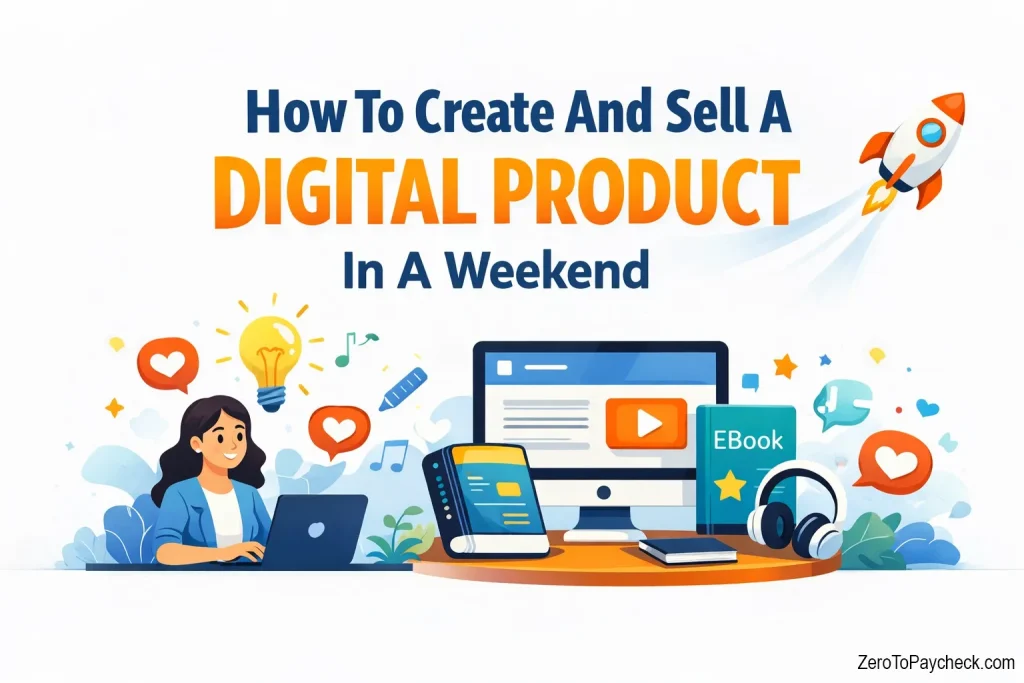
What you’ll learn: A complete Friday-to-Sunday roadmap for creating and selling a digital product — from idea validation to your first sale — even if you have zero followers, no email list, and no website.
Here’s a confession: the first digital product I ever built took me six months. Six months of tweaking fonts, rewriting sections, second-guessing the title, and convincing myself it had to be perfect before anyone saw it. When I finally launched it, I made exactly four sales. Two were from my mom.
The second product I built took me a Saturday afternoon. I threw it up on Gumroad before dinner, posted about it in one Facebook group, and woke up Sunday morning to eleven sales. It was a basic, slightly ugly budget spreadsheet template. No launch sequence. No email list. No fancy branding.
That experience broke my brain a little. And then it changed everything about how I think about creating and selling a digital product.
You’re probably reading this because you’ve been in “planning mode” for a while. You have knowledge, skills, maybe even a half-baked idea — but you keep waiting for the right moment, the right platform, the right level of readiness. I get it. The internet is full of advice telling you to build an audience first, start a newsletter, set up a funnel, create a lead magnet, establish a brand identity…
Honestly? For beginners, that advice is paralyzing. And often wrong.
The weekend sprint model flips all of that. The constraint of 48 hours isn’t a limitation — it’s the whole point. A tight deadline forces you to make decisions instead of deliberating. It forces you to ship something real instead of chasing something perfect. And it gives you data — actual customer feedback — that no amount of planning ever could.
This isn’t a get-rich-quick scheme. You might make $50 this weekend. You might make $500. Results vary enormously based on the problem you solve and how you reach people (more on that honestly later). But I can tell you this: nothing will teach you more about making money online than actually doing it once, even imperfectly.
Here’s the roadmap. Let’s go.
Why “Fast” Beats “Perfect” (The Psychology of the Weekend Launch)
There’s a reason NASA uses sprint cycles. There’s a reason startups talk about Minimum Viable Products. It’s not because they’re lazy. It’s because done and imperfect generates feedback; perfect and unfinished generates nothing.
A 2021 survey by ConvertKit found that creators who launched their first digital product within 30 days of the idea were significantly more likely to still be selling something 12 months later than those who spent longer in pre-launch mode. The act of shipping — even something rough — builds the muscle memory and the confidence to keep going.
Here’s what surprised me when I got into this: the “boring” products almost always outsell the passion projects. I spoke with a designer in my mastermind group who spent three weeks building a beautifully illustrated e-book about color theory — something she genuinely loved. She made maybe $200 in six months. The Canva social media templates she knocked out in an afternoon? Those have made her over $8,000. Same skill set. One product took 20x longer and earned 40x less.
“Speed and specificity beat scale and complexity — every time — for a first launch.”
The weekend sprint is also psychologically protective. You’re not betting your identity on it. You’re running an experiment. That framing matters enormously for people who’ve been stuck in perfectionism. If it doesn’t work, you lost a weekend. If it does work — and it often does, at least a little — you have proof of concept and a model to repeat.
Who this method is for: people who already have a skill, knowledge base, or process that other people could benefit from. Teachers, designers, marketers, project managers, fitness coaches, photographers, writers, accountants. If someone has ever asked you “how do you do that?” — you have a digital product hiding in your head.
Who it’s not for: anyone looking for a push-button money printer with no input. That thing doesn’t exist. Anyone selling you that is selling a course on how to sell courses they’ve never actually sold.
→ Related: Best Lead Magnet Ideas to Build Your List After Your First Sale
Grab a notebook. Draw three columns. Label them: What I Know, What People Ask Me, and What I’ve Automated.
The first bucket is your expertise — things you understand at a level most people don’t. The second is your proven demand — these are the topics where people have literally raised their hand and said “I need help here.” The third bucket is gold: anything you’ve built a system, template, or shortcut for because doing it manually was too slow.
Now look for overlap. The idea that shows up in all three columns? That’s your weekend product.
A friend of mine from a marketing mastermind launched a poorly-designed, zero-frills content calendar on a Friday night — she’d answered questions about her editorial process so many times she figured she’d just package the Google Sheet. She woke up Saturday morning to $340 in sales because the timing was right (New Year’s week) and the problem was real. The design was genuinely ugly. Nobody cared.
Don’t skip this step. Ten minutes now saves you ten hours of building something nobody wants.
Budget trackers. Meal planning templates. Invoice spreadsheets. Project management Notion dashboards. Job application trackers. Weekly planner PDFs.
These are not glamorous. And they consistently outsell elaborate e-books about passion topics. Why? Because they solve a specific, immediate, painful problem. People searching for a “freelance invoice template” have their wallet out. They need a solution right now.
Compare that to someone browsing a “guide to creative fulfillment.” That’s a want, not a need. Needs convert. Wants browse.
7 Digital Product Types You Can Build in a Day:
→ Related: How to Drive Traffic Without Social Media (Especially to Digital Products)
Keep it simple. You don’t need to learn new software this weekend. Here’s what works:
Let me be blunt about something: in my experience, the quality of the marketing matters way more than the quality of the PDF. A product that solves a real problem and reaches the right person will sell. A beautifully designed product that nobody knows about won’t.
Stop optimizing the cover. Stop fiddling with the color palette. Stop rewriting the intro for the fourth time.
Here’s a test: if someone could use your product to solve their problem, it’s done enough to sell. Ship it.
I once spent three hours perfecting the typography in a PDF guide — kerning, line-height, footnote formatting. Three hours. You know what the first three customer reviews mentioned? Not the fonts. They talked about the content, the framework, the fact that it saved them time. Nobody noticed the typography. Nobody. The obsession over visual polish is almost always about the creator’s ego, not the buyer’s needs.
This is the one place where a little design effort genuinely pays off. Your preview — the sample pages or screenshot you’ll use in your product listing — is doing actual sales work. A few rules:
→ Related: How to Sell Digital Downloads on Etsy — A Beginner’s Complete Guide
Building a product nobody asked for. This is the big one. If you didn’t validate the idea first — even for ten minutes — you’re creating for yourself, not for a buyer. Before you build anything, confirm that real people have expressed the problem your product solves. Reddit threads, Etsy reviews, Amazon complaints, Facebook group questions. Evidence first. Creation second.
Getting stuck on branding. You do not need a logo this weekend. You don’t need a domain name. You don’t need a brand color palette or a business name or an LLC (though consult a professional on the legal side — see below). These are things you build after you have proof that people want what you’re selling. Getting lost in a Canva logo generator on Saturday afternoon is one of the most reliable ways to miss your Sunday launch window.
Imposter syndrome pricing. Charging $3 for something that saves someone an hour of work every week isn’t humble — it’s a miscalculation. Your price is a signal of value. If you’ve built something genuinely useful, price it accordingly. A $3 product and a $27 product require the same marketing effort, but one pays you nine times more per sale. Price for the transformation, not for your current confidence level.
Skipping the “thank you.” When your first sale lands, send a personal thank-you message if the platform allows it. Not an automated email — a real, human note. “Hey, thanks for picking this up. If you have any questions or feedback, I’d genuinely love to hear it.” This is how you get your first reviews, your first testimonials, and occasionally, your first word-of-mouth referral. Don’t underestimate it.
Let’s be real about the timeline, because most articles in this space oversell the immediacy and undersell the potential.
Week one: You’ll likely get a handful of sales if you execute the 1-1-1 strategy — maybe 2 to 10. Maybe zero. Zero is data, not failure. It means something about the marketing needs to change (usually specificity and reach), not that the idea is dead.
Month one: Most people experience what I call the “post-launch slump” — the initial burst of sales from your network fades and organic traffic hasn’t kicked in yet. This is normal. This is when you do two things: ask your early buyers for feedback and reviews, and start exploring one additional traffic channel (Pinterest, Etsy SEO, a Reddit post in a relevant community).
Month three: If you’ve collected feedback and done at least one product update based on it, sales typically stabilize. You now have social proof (reviews), a refined product, and a better understanding of who your buyer actually is. This is when a digital product starts to feel like digital real estate — an asset that generates income without requiring your constant attention.
Year one: The creators who are genuinely building passive income at this point aren’t the ones who launched one perfect product. They’re the ones who ran the weekend sprint four or five times, kept what worked, and built a small catalog. Pat Flynn of Smart Passive Income has talked extensively about how a portfolio of small, specific products outperforms one large, general product — over and over again.
→ Related: Passive Income Tax Tips for Digital Product Creators — What to Set Aside
It happens. It’s frustrating. It’s also mostly a smaller problem than people fear. The vast majority of your buyers are honest. For high-risk products, Gumroad and Payhip both have options to limit download attempts and add license keys. But honestly? The energy spent worrying about piracy is better spent on marketing. Nobody pirates a product that isn’t worth having — so if people are stealing it, that’s actually signal that you’ve built something valuable.
This varies by country and state/province. In the U.S., most people selling digital products as a side hustle operate as sole proprietors initially — which requires no formal registration in most states. However, once you’re generating consistent income, forming an LLC offers liability protection and can have tax advantages. Talk to a licensed accountant or attorney about your specific situation. Don’t let this become a reason to delay launching — you can sort the legal structure after you’ve confirmed people actually want what you’re selling.
Yes — with one important qualifier. You don’t need to be the world’s foremost authority. You need to be a few steps ahead of your buyer. If you’ve figured out how to manage a freelance business’s finances using a spreadsheet system, and someone just starting out would benefit from that system, you’re qualified to sell it. “Expert” is relative. The person who learned something six months ago can absolutely help the person who’s starting today. Just be honest about your experience level in your product description.
⚡ Quick Answer: Leverage platforms with built-in search traffic. Etsy has millions of monthly buyers actively searching for digital downloads — a well-optimized listing gets organic visibility from day one. Pinterest is massively underutilized for digital products; a single pin linking to your Gumroad product can drive consistent traffic for months. Reddit posts in hyper-relevant subreddits (where sharing resources is allowed) can generate bursts of targeted traffic. You don’t need followers — you need to be findable by people who already have the problem you’re solving.
Building in silence and expecting results. The people who make their first sale in week one almost always told someone about it — specifically, personally, and with context about who it helps. The people who make no sales in month one almost always “launched” by posting one vague tweet and waiting. Marketing a digital product at this stage is a direct, personal, specific activity. Find the person who has the problem. Tell them you have a solution. That’s the whole game.
Here’s what the weekend sprint really gives you — beyond the potential income, beyond the product itself: it gives you proof that you can do this. That you can have an idea on a Friday, build something real by Saturday night, put it in front of people on Sunday, and see actual money move because of your knowledge and effort.
That experience is irreplaceable. No course, no blog post, no podcast episode can substitute for it. And once you have it, the paralysis breaks. The perfectionism loses its grip. You realize that the version of you waiting for “ready” was always going to be waiting.
Speed. Specificity. Shipping. Those are the three things that separate the creative entrepreneurs who build real income from the ones who keep planning to.
The best time to start was last Friday. The second best time? This Friday night. Pick your idea tonight. Validate it before you go to sleep. Wake up Saturday ready to build.
And look — if you make your first sale, I genuinely want to hear about it. That moment is worth celebrating.