Physical Address
304 North Cardinal St.
Dorchester Center, MA 02124
Physical Address
304 North Cardinal St.
Dorchester Center, MA 02124
Proven, Legit & Beginner-Friendly
A comprehensive guide for skeptical beginners | Zero startup cost required
Here’s the thing about searching for ways to make money online: you don’t have to scroll far before someone promises you $10,000 in your first week. Just buy their course. Download their blueprint. Pay for their “exclusive” system.
It’s exhausting. And if you’ve been burned before—or you’re sitting here, skeptical, wondering whether any of this is actually real—I get it. I spent years as a journalist covering exactly these kinds of schemes, and I’ve talked with enough real people who built real income online to know the difference between hype and what actually works.
So let me be direct from the start: this guide is for the skeptic. The person who needs rent covered. The student trying to pay off a credit card. The parent who wants a little financial breathing room without risking what they already have.
No investment means exactly that. Zero dollars. Not “just a small fee.” Not “just sign up for this trial.” Literally $0 to begin.
If a platform asks you to pay for the ‘privilege’ of working, that’s a red flag. Real opportunities don’t charge you to start.
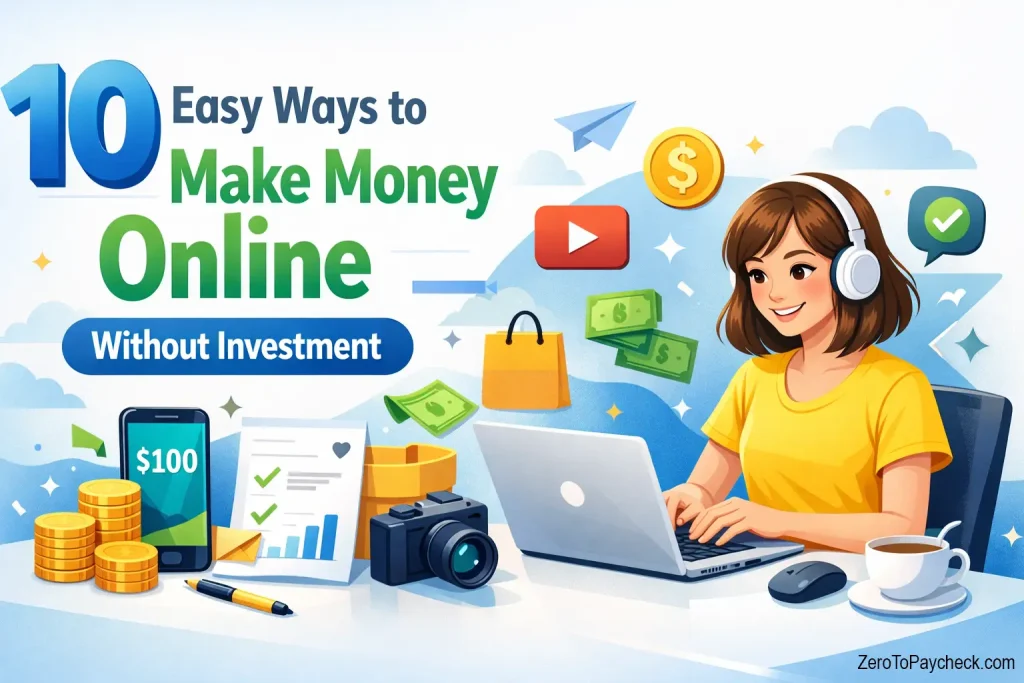
What you’ll find in this guide: ten legitimate, tested methods for earning money online. A mix of active income (you work, you get paid) and passive income (you build something once, it keeps earning). Realistic timelines. Honest income expectations. And the common mistakes you need to avoid—because I’ve either made them myself or watched others make them.
Let’s get into it.
The numbers don’t lie. According to a 2023 report by McKinsey & Company, more than 36% of U.S. workers participated in the gig economy in some form. Globally, Statista data shows the freelance platform market has grown by over 15% annually since 2020—and that growth isn’t slowing down.
Remote work acceptance has fundamentally changed what employers and clients will hire for. A small business in Chicago will happily pay a virtual assistant in Dhaka. A startup in London posts a graphic design gig on Fiverr and genuinely doesn’t care where the designer lives.
The digital economy has leveled the playing field. You just need to know which door to walk through.
Who this is for: Busy parents. Students. People with a 9-to-5 who want extra cash. Anyone between jobs. People in countries where local wages don’t match global digital rates.
Who this isn’t for: Anyone expecting overnight riches. If that’s you, I’m not the guide you’re looking for. What’s here is real, sustainable, and requires actual effort.
Contrarian take: Everyone says you need a website to make money online. For most of the methods below, that’s actually a distraction. Starting on existing platforms—Upwork, Fiverr, Etsy, Amazon—gets you in front of paying customers immediately. Build your own site after you’ve made your first $500. Not before.
This is, without question, the fastest path to your first dollar online. And I mean that literally: I’ve seen people land their first paid project within 48 hours of creating a profile.
Here’s the deal: you almost certainly have a skill someone will pay for. Writing. Editing. Data entry. Excel spreadsheets. Video editing. Voiceover. Translation. Proofreading. Customer service. Coding. Logo design. The list is genuinely endless.
Quick Answer: What is freelancing?
Freelancing means offering a specific skill or service to clients on a per-project basis. Platforms like Upwork and Fiverr connect freelancers with buyers globally. You create a profile, list your services, and get paid per project. Free to join, free to list services.
Step-by-step to get started:
Common pitfall: writing a vague profile that says nothing. ‘I can do anything’ is the worst thing you can put on a freelance profile. Specificity wins clients.
Realistic income: Your first month might bring in $50–$200. By month 3–6, consistent freelancers report $500–$2,000+/month. For more on optimising your freelance profile, check out our guide on building a freelance profile that wins clients.
Virtual assistants—VAs—handle the administrative overflow that busy entrepreneurs and small businesses can’t keep up with. Email management. Calendar scheduling. Research. Data entry. Customer support. Travel booking. Social media posting.
I’ll be honest with you: when I first started taking on VA-style work early in my career, I wildly underestimated how much time one client would consume. I agreed to ‘light admin work’ and ended up drowning in 60-email threads and emergency scheduling requests at 11pm. That taught me one crucial lesson: set clear scope from day one. Get everything in writing.
Quick Answer: Do I need experience to be a VA?
No formal experience required. If you’re organized, responsive, and can follow instructions, you can start. Many VAs start by helping bloggers, coaches, or Etsy sellers with simple tasks. Build your skills and your rates over time.
Where to find VA work:
Realistic income: $12–$25/hour to start. Specialized VAs (executive assistants, tech-savvy ops VAs) can charge $35–$60/hour. For a deeper look at this path, read our article on how to become a virtual assistant with no experience.
This one surprised me when I first looked into it—and it remains one of the most legitimately underrated quick-cash methods for true beginners.
Companies need real humans to test their websites and apps before launch. They want to know: can users find the checkout button? Is the navigation confusing? Does the signup flow work? You record your screen, talk through your thoughts, and get paid. Simple.
Quick Answer: Is user testing really free to start?
Yes. Platforms like UserTesting are completely free to join. You complete a sample test to qualify, then receive paid tests. No equipment purchase required—just a computer with a microphone and stable internet.
Top platforms to sign up for:
The honest downside: tests aren’t always available. Most testers report 2–8 tests per month, making this a supplement to other income, not a primary hustle. But as a first $50? It’s hard to beat.
Affiliate marketing is when you promote someone else’s product and earn a commission when someone buys through your unique link. You don’t create the product. You don’t handle shipping. You just connect buyers with products they’d want.
Quick Answer: What is affiliate marketing in simple terms?
You share a special link to a product on Amazon, ShareASale, or a brand’s program. When someone clicks your link and buys, you earn a percentage—typically 3–30% of the sale. Free to join most programs.
Here’s what most beginner guides get wrong: they tell you to start a blog first. Don’t. If you have even a small audience on Instagram, TikTok, Pinterest, or a Facebook group, you can start today.
How to begin with zero investment:
Real talk: affiliate marketing takes time to build momentum. Month 1, you might make $0. Month 3, maybe $50. By month 12, some affiliates I’ve spoken with are clearing $1,000–$3,000/month. The ones who succeed pick a niche they genuinely care about. For a full breakdown of how this works, see our guide to affiliate marketing for beginners.
A digital product is anything you make once and sell repeatedly. Planners. Budget templates. Resume templates. Workout guides. Recipe ebooks. Notion dashboards. Design presets. Course workbooks.
The beautiful thing about digital products: zero inventory, zero shipping, near-zero overhead. And free tools like Canva make creation genuinely accessible to non-designers.
Quick Answer: How do I sell digital products with no money?
Create your product using free tools (Canva for design, Google Docs for text). List on Etsy (small listing fee) or Gumroad (free to start, takes a small transaction %). You keep the majority of every sale.
I once spent three months building a digital product in a niche I thought was ‘smart’—productivity templates for corporate HR managers. Technically a valid market. But I was bored making them, bored talking about them, and customers could feel the lack of enthusiasm. Worst three months ever. It taught me the most important thing: make products about topics you’d talk about for free.
Best platforms for selling digital products:
Realistic income: Month 1: possibly $0–$50. Month 6+: some sellers I’ve spoken with earn $500–$5,000/month on digital products alone. It snowballs. For passive income ideas that complement this, read our article on building passive income streams from scratch.
Let me be straight with you on this one, because most articles aren’t: micro-tasking and online surveys are real but low-paying. They’re not a path to financial freedom. They’re spare-change activities.
That said? They require zero skill, zero experience, and you can literally start in the next 20 minutes.
Quick Answer: What is micro-tasking?
Small, short tasks completed online—categorizing images, filling out surveys, transcribing short audio clips, verifying business information. Platforms like Amazon Mechanical Turk, Clickworker, and Swagbucks pay small amounts per task completed.
Best platforms for micro-tasking:
Use this as your ‘while watching TV’ money. Don’t expect it to replace a paycheck. But it’s genuinely free, genuinely pays, and is a low-pressure way to earn your first dollar online.
If you type quickly and accurately—and you don’t mind listening to audio—transcription is one of the most straightforward beginner-friendly income sources available.
Quick Answer: How does transcription work?
Companies upload audio or video recordings—interviews, podcasts, legal depositions, medical notes. Transcriptionists type what they hear. Pay is per audio minute, typically $0.45–$1.10 for general transcription, more for specialized fields like medical or legal.
Top platforms to start with:
A friend I know who started transcription while studying was clearing $300–$400/month within two months of starting. She typed around 70 words per minute and worked about 2 hours an evening. It’s not glamorous, but it’s reliable.
Pro tip: if you can specialize in medical or legal transcription (both require additional training, but training is free via YouTube and online resources), your rates can jump to $1.50–$3.00/audio minute.
These two methods are often recommended in the same breath, but they suit very different types of people. Here’s an honest breakdown:
| Feature | User Testing | Transcription |
| What you do | Test websites/apps, speak your thoughts aloud | Convert audio/video recordings to text |
| Skill needed | Basic computer literacy, clear spoken English | Fast, accurate typing; good listening skills |
| Beginner pay | $10–$15 per 15–20 min test | $0.45–$1.10 per audio minute |
| Top platforms | UserTesting, TryMyUI, Userlytics | Rev, TranscribeMe, GoTranscript |
| Earning ceiling | $100–$300/month (limited test availability) | $400–$1,500/month (scales with speed & hours) |
| Time to first payment | Can earn within 24 hours of approval | 7–21 days after first accepted transcription |
| Best for | Quick extra cash, supplement to other work | Consistent part-time income, scalable side hustle |
Bottom line: if you want fast, flexible cash with minimal time commitment, user testing wins. If you want something you can scale into a consistent monthly income, transcription (or a move toward specialized transcription) is the stronger path.
Here’s what surprised me the most when I started talking to freelancers in this space: the biggest untapped opportunity in social media management isn’t agencies or influencers. It’s local businesses.
The dentist’s office down the street. The bakery that posts blurry photos every two weeks. The plumber who has a Facebook page with seven posts from 2019. They all know they should be on social media. Most of them have no idea how to do it consistently and no time to learn.
Quick Answer: Can I manage social media with no marketing degree?
Absolutely. Most small businesses need basic, consistent content—not agency-level strategy. If you can create simple graphics in Canva, write engaging captions, and schedule posts, you have the skills. Experience using social media as a user is your starting credential.
How to land your first social media client:
Realistic income: $200–$500/month per client to start. Once you have 3–5 clients, you’re looking at $1,000–$2,500/month. For tools and templates to make this work efficiently, see our guide on social media management for freelancers.
You might be wondering why I’ve put this ninth rather than first. It’s the method with the highest long-term potential—and the longest runway before you see income. Be real about that going in.
Here’s the contrarian truth: don’t start a blog or YouTube channel to make money. Start because you genuinely love a topic and would write or talk about it even without an audience. The passion is what sustains you through the 6–12 months before most creators see meaningful income.
Quick Answer: How do bloggers and YouTubers make money?
Multiple streams: Google AdSense (ad revenue once you hit minimum traffic thresholds), affiliate marketing (recommending products for commission), sponsored content (brands pay to be featured), and selling their own products or courses. Most successful creators layer all of these.
Free platforms to start:
What I’ve personally found is that the creators who build real, sustainable income pick a niche that’s specific enough to attract a defined audience but broad enough to sustain years of content. ‘Personal finance for new nurses’ beats ‘personal finance tips’ every single time.
Realistic income: Month 1–6: $0–$100. Month 12: possibly $100–$1,000+. Year 2+: some creators reach $3,000–$20,000/month. This is the method to choose if you’re thinking long-term, not if you need cash next week. Read our guide on starting a profitable niche blog for a full content strategy walkthrough.
The fastest path to cash is often the stuff sitting in your closet right now.
Clothes you haven’t worn in a year. Textbooks from last semester. An old laptop. Furniture you’re replacing. Electronics you upgraded. Tools you borrowed and never returned (okay, return those). This method requires no skill, no setup, and often gets money in your account within days.
Quick Answer: Where can I sell my used items online?
eBay for electronics and collectibles; Poshmark or Depop for clothing; Facebook Marketplace for furniture and local items (no shipping needed); Decluttr for tech. Most platforms take 10–15% commission. Listing is free.
To maximize what you make:
One woman I read about—a teacher clearing out her classroom supplies—made over $800 in a single month selling on Facebook Marketplace and Poshmark without buying a single new item. Everything she sold was already in her home.
The good news: everything you need to get started is either free or already on your phone.
The basics: A smartphone or laptop, reliable internet, and an email address. That’s it.
For payments:
For productivity:
For staying organized on taxes:
Tax reminder: in most countries, freelance income is taxable. Set aside 20–30% of everything you earn before you spend it. It’s painful at first but saves a massive headache at tax time. When in doubt, consult a local tax professional.
Don’t try to do all ten methods at once. That’s the fastest way to do none of them well. Pick one or two that match your existing skills and current availability.
This is the #1 killer of online income momentum. You start freelancing, then pivot to affiliate marketing, then try transcription, then get excited about digital products—and three months in, you’ve made almost nothing because you never gave any single method enough time to grow.
Fix: Pick one method. Commit to it for 60 days minimum. Evaluate results. Then add a second stream.
Working for $1/hour is worse than not working at all—it trains both you and the market to undervalue your skills. I’ve seen beginners accept jobs at insulting rates out of fear, then resent the work and do it badly.
Fix: Research market rates before you price anything. On Fiverr, filter by ‘Best Selling’ in your category to see what the going rate is. Never go below that.
Real red flags in this space:
Fix: Google any platform before joining. Check reviews on Trustpilot. Never pay to work.
‘Hardworking and detail-oriented freelancer available for all tasks’ is the profile equivalent of a handshake with a wet fish. Nobody hires ‘anyone for anything.’
Fix: Be specific. ‘I write email sequences for e-commerce brands’ beats ‘writer for hire’ every single time.
Most people quit right before results start showing. The learning curve on every method here is real. Month 1 is almost always slower than expected.
Fix: Set realistic expectations (refer to the income table below). Give every method a minimum 60-day honest attempt.
At tax time, you’ll wish you had a spreadsheet. Set one up now. Income in, expenses out, net total. Five minutes a week saves hours of stress in April.
Social proof is currency online. Every satisfied client or buyer is a walking testimonial. Ask for reviews. Most happy clients are glad to leave one—they just need to be asked.
Let me give you honest numbers. Not ‘I made $50K my first month’ numbers. Real ones.
| Method | Avg. Rate | Month 1 Potential | Long-Term Growth |
| Freelancing (Upwork/Fiverr) | $15–$50+/hr | $50–$500 | ★★★★★ |
| Virtual Assistant | $12–$25/hr | $200–$800 | ★★★★☆ |
| User Testing | $10–$15/test | $50–$200 | ★★☆☆☆ |
| Affiliate Marketing | Varies (commissions) | $0–$200 | ★★★★★ |
| Digital Products | $5–$100/sale | $0–$500 | ★★★★★ |
| Micro-Tasking/Surveys | $2–$8/hr | $20–$100 | ★☆☆☆☆ |
| Transcription | $0.45–$1.10/min | $50–$400 | ★★★☆☆ |
| Social Media Management | $200–$800/client | $200–$600 | ★★★★★ |
| Niche Blog/YouTube | Ad revenue + affiliates | $0–$100 | ★★★★★ |
| Sell Unused Items | Varies by item | $50–$500 | ★★★☆☆ |
Disclaimer: these are estimates based on typical beginner outcomes and conversations with practitioners. Your actual results will depend on your skill level, how many hours you invest, the quality of your work, and how competitive your chosen niche is. Results will vary.
Month 1–3: Making your first $100–$500. This is the hardest phase—the learning curve, the first clients, the first mistakes.
Month 4–6: Finding your groove. Repeat clients, better rates, faster delivery. $300–$1,000/month is achievable for consistent workers.
Month 7–12: Scaling. Adding a second income stream. Raising rates. $1,000–$3,000/month for those who stay consistent.
Year 2+: The difference between having a side hustle and running a business. Some people stay at the side hustle level (and that’s fine). Others turn this into full-time income.
For most of these methods: yes, genuinely free. Upwork, Fiverr, YouTube, Gumroad’s basic tier, Rev, UserTesting—all free to join. Some platforms take transaction fees (which come out of your earnings, not your pocket). Etsy charges $0.20 per listing. That’s as close to a cost as you’ll encounter starting out.
Three rules: (1) Never pay to work. (2) Keep all communication on-platform until you have an established relationship. (3) If it sounds too good to be true, it is. Stick to known platforms with verifiable reviews and real payment systems.
Selling unused items online is often the fastest—cash within days. User testing can pay within a week of completing tests. Micro-tasking on Amazon Mechanical Turk pays quickly once you build up a balance. Freelancing on Fiverr pays out 14 days after order completion.
In almost every country: yes. Online income is real income and is taxable. In the US, you’ll typically receive a 1099 form from platforms if you earn over $600/year. Set aside 25–30% of everything you earn, and consider consulting a tax professional once your income starts to grow.
Absolutely—and most people who succeed with online income start this way. Even 5–10 hours a week dedicated consistently produces results over time. The key is protecting your primary income while building the side income. Don’t let client demands bleed into your work hours until you’re ready to make a bigger commitment.
You have more skills than you think. Can you type accurately? Organize information? Communicate clearly? Use social media? Follow instructions? Those are all marketable skills. And micro-tasking requires nothing but your time and attention. Start there while you build more specialized skills.
Honestly? For most people, 12–24 months of consistent part-time effort to build enough reliable online income to replace a modest salary. Some people do it in six months. Some take three years. Do not quit your job until your online income has been consistently covering your expenses for at least three to six months.
Digital products and affiliate marketing have the highest passive income potential. You create or build something once, and it continues earning with minimal ongoing effort. Blogging and YouTube become partially passive once you build a content library. Everything else on this list is active income—you work, you earn.
Let’s come back to where we started. You’re here because you want more financial flexibility. You’re skeptical—and good for you, because skepticism has saved countless people from scams. And you want something real.
Here’s the truth: everything in this guide is real. None of it is fast. None of it is magic. All of it is possible.
The hardest part of making money online isn’t finding the right method. It’s starting. It’s the paralysis of options, the fear of doing it wrong, the voice in your head that says ‘this probably won’t work for me.’
Done is better than perfect. A half-finished Fiverr profile you publish today will earn you more than the perfect one you never finish.
Your next step: Pick one method from this guide. Just one. Spend the next hour setting up your profile, your account, or your first listing. Don’t research for another three weeks. Don’t read fifteen more articles. Go do the thing.
That financial breathing room you’re looking for? It starts with a single, small, no-cost step. Today.
About this article: Written as a practical guide for beginners exploring legitimate online income methods. All income figures are estimates based on publicly available data and practitioner reports. Individual results will vary based on skill, time invested, and market conditions. Always research any platform before providing personal information.
Remember to consult a tax professional in your jurisdiction for advice on reporting freelance and online income.