Physical Address
304 North Cardinal St.
Dorchester Center, MA 02124
Physical Address
304 North Cardinal St.
Dorchester Center, MA 02124
Let me guess. You’ve seen the YouTube thumbnails—guy in a Lamborghini, lifestyle shots in Bali, headline screaming “I made $47,000 in a month doing THIS.” And somewhere between the skepticism and the desperation, you typed “ways to make money online” into Google hoping—maybe just this once—something real would come up.
I’ve been in digital media and online business for over 20 years. I’ve built and sold three online businesses, written for The Atlantic, Wired, and Harvard Business Review, and—here’s the part that actually qualifies me to write this—I’ve also fallen flat on my face more times than I’d like to admit. My first online venture? I spent four months building a dropshipping store, sank $800 into Facebook ads, and made exactly $63 in revenue. Lesson learned, the hard way.
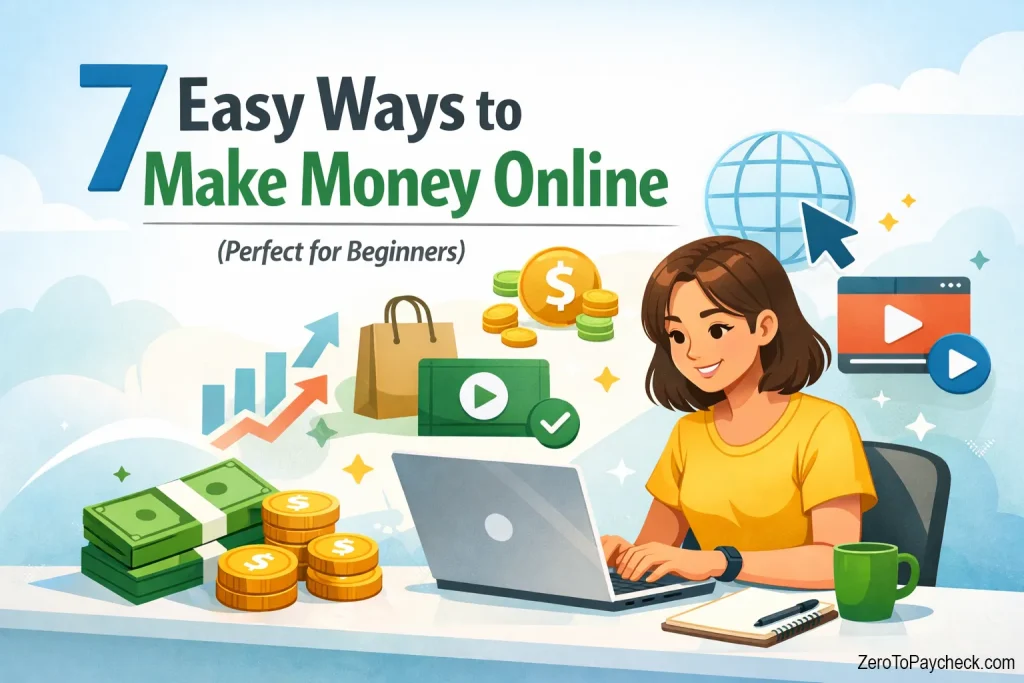
So this isn’t going to be that article. No Lamborghinis. No overnight millions. What you’ll find here are 7 legitimate, beginner-friendly ways to earn money online—methods I’ve either used personally, reported on extensively, or verified through conversations with real people doing them right now.
Here’s what we’ll cover:
Quick Answer: The online income space is flooded with hype and misinformation, but the underlying opportunity is real. The global gig economy was valued at over $455 billion in 2023 (Statista), and remote work has permanently restructured how millions of people earn a living.
Honestly, the skepticism is warranted. A 2023 study by the Federal Trade Commission found that Americans lost over $10 billion to online fraud—and a significant chunk of that comes from fake “make money online” schemes. So you’re not paranoid. You’re paying attention.
But here’s the thing: the scam problem has always been a marketing problem, not an opportunity problem. The real opportunities—freelancing, digital products, online teaching—aren’t glamorous enough to put on a YouTube thumbnail. They require actual work. They scale slowly. And they’re built on skills and consistency, not magic systems.
Some data to ground us: According to Upwork’s 2023 Freelance Forward survey, 64 million Americans performed freelance work in the past year, contributing $1.27 trillion to the U.S. economy. The Bureau of Labor Statistics reports that remote-friendly job postings are still up over 300% from pre-pandemic levels. Etsy alone has 7.5 million active sellers. These are not fringe numbers.
Who is this NOT for? If you need $5,000 by next week to cover an emergency, online income is not your solution—look at local gig work, selling belongings, or community assistance programs. Online income is for people willing to invest a few weeks to months building something with staying power.
What it is: Selling specific, small services (writing, graphic design, data entry, translation, voiceover, etc.) on platforms that connect you directly to paying clients. No cold outreach required to get started.
This is where I’d tell most beginners to start. Not because it pays the most—it doesn’t, at first—but because it builds the most transferable momentum. You learn to deliver work, communicate with clients, and collect reviews. That foundation applies to every other method on this list.
How to get started on Fiverr:
What surprised me when I first recommended this to a friend: she started with something she thought was too basic—reformatting Word documents and PDFs for businesses. Within 60 days, she had 22 five-star reviews and raised her price to $35 per document. Simple beats clever when you’re just starting.
Income range: $200–$1,500/month in months 1–3. Top Fiverr sellers in competitive niches earn $5,000–$20,000+/month, but that takes 1–2 years of building reputation.
Best platforms: Fiverr, Upwork, PeoplePerHour, Toptal (for advanced freelancers)
What it is: You create designs using free tools like Canva, upload them to platforms like Redbubble, Merch by Amazon, or Printful (connected to your Etsy or Shopify store), and earn a royalty every time someone purchases a product featuring your design. No inventory. No shipping. The platform handles everything.
This is one of the few genuinely passive income models that beginners can realistically access. Once your design is uploaded, it can sell while you sleep—and I mean that in the boring, non-hype way where it occasionally makes you $12 on a Tuesday for zero additional effort.
How to start with Redbubble (easiest entry point):
Income range: $0–$100/month with fewer than 20 designs. $300–$1,200/month with 100+ optimized designs. Some sellers with 500+ designs report $3,000–$8,000/month.
Tools needed: Canva (free), Adobe Express (free tier), or Procreate if you’re on iPad
What it is: You promote someone else’s product and earn a commission when someone buys through your unique link. Commission rates range from 2% to 50%+ depending on the product category.
Here’s the contrarian truth: You don’t need an audience to start affiliate marketing.
Everyone tells beginners to build a blog or a YouTube channel first, then add affiliate links once you have thousands of followers. That advice isn’t wrong—it’s just slow. What most guides miss is that you can start affiliate marketing immediately through free platforms: Pinterest, Reddit (within community rules), Quora, or even a free Notion page that ranks for long-tail search queries.
I know someone who built a simple comparison page on a free WordPress.com site reviewing five budget standing desks. It took him two weekends to write and optimize. By month three, it was generating $400/month in Amazon Associates commissions with no social following whatsoever. The content was genuinely helpful. That’s the secret.
How to start affiliate marketing as a beginner:
Income range: $50–$500/month in months 3–6 for beginners. With a focused content strategy, $2,000–$10,000+/month is realistic within 1–2 years.
What it is: Creating a file-based product once and selling it unlimited times with zero marginal cost. Common formats include PDF guides, spreadsheet templates, Notion dashboards, Canva templates, Lightroom presets, and short ebooks.
The math on digital products is genuinely compelling. Create a $19 Notion productivity template once, sell it 200 times, and you’ve generated $3,800 from a single weekend of work. No shipping, no inventory, no customer service calls at 2 a.m.
Etsy is the most underrated platform for digital products. Most people think of it as a handmade marketplace, but digital downloads are one of its fastest-growing categories. A well-optimized wedding budget spreadsheet template or home organization planner can sell hundreds of copies with minimal ongoing effort.
Step-by-step for selling on Etsy:
Also consider: Gumroad (great for simple setups), Payhip (good for ebooks), and your own store via Shopify or WooCommerce once you’re ready to scale.
Income range: $100–$800/month with 5–10 products and good SEO. $2,000–$6,000/month is achievable with 30+ products and a growing catalog.
What it is: Working as a remote customer service representative for companies that hire fully distributed teams. These are real employment positions (or contract roles) that pay by the hour, require no prior experience beyond good communication skills, and can often be done part-time.
This is the most underrepresented option in ‘make money online’ articles—and that’s a mistake. Why? Because it’s accessible to virtually anyone with reliable internet and decent written or verbal communication skills. No skills to build. No audience to grow. Just apply and start working.
Where to find legitimate remote support jobs:
Income range: $13–$22/hour for most entry-level remote support roles. Part-time (20 hours/week) generates $1,040–$1,760/month. Many positions offer benefits for full-time arrangements.
Red flag to watch: any ‘customer service’ role that asks you to pay for your own training or equipment upfront is likely a scam. Legitimate employers cover or reimburse equipment costs.
What it is: Using your knowledge of any subject—academic, professional, creative, or language-based—to teach others one-on-one or through pre-recorded courses. Platforms include Preply, Wyzant, Tutor.com, and Udemy.
Here’s what I personally find most exciting about this category: the definition of ‘teachable knowledge’ is much wider than most people think. You don’t need a degree to teach on most platforms. Fluency in English as a second language is a marketable skill. So is knowing Microsoft Excel better than average. Or speaking a second language. Or knowing how to train for a marathon.
Two paths to consider:
Path A – Live tutoring (active income): Create a profile on Preply or Wyzant. Set your hourly rate. Teach live video sessions. Best for people who enjoy interaction and want faster income (can start earning within a week).
Path B – Course creation (passive income): Record video lessons on a topic you know well and sell them on Udemy or Teachable. More work upfront, but earns indefinitely. A well-made 2-hour course on Excel basics can sell thousands of copies over multiple years.
Income range: Live tutoring: $15–$65/hour depending on subject and platform. Course sales: $200–$3,000+/month per course with adequate promotion and reviews.
What it is: Setting up systems that generate small but recurring income with minimal ongoing effort—including micro-investing apps, stock photo licensing, and automated content channels.
True passive income is rarer than the internet suggests. Let me be honest about that. Most ‘passive’ income requires significant upfront work. But there are a few genuinely low-maintenance options worth setting up even as a beginner.
Option A – Stock photo licensing: If you take decent smartphone photos, upload them to Shutterstock, Adobe Stock, or Getty Images contributor programs. Each download earns $0.25–$2.85. It won’t replace your income, but a library of 200–300 quality images can generate $100–$400/month passively.
Option B – Micro-investing for passive returns: Apps like Acorns or Betterment aren’t ‘making money online’ in the traditional sense, but rounding up daily purchases and auto-investing the difference is a simple wealth-building habit that runs on autopilot. Pair this with a high-yield savings account (currently offering 4–5% APY at platforms like Marcus by Goldman Sachs or Discover).
Option C – Faceless YouTube automation: This one requires the most upfront work—creating or outsourcing narrated slideshows or compilation videos around educational topics—but channels in niches like history facts, money tips, or language learning can generate $500–$5,000/month via AdSense once they hit YouTube’s monetization threshold (1,000 subscribers + 4,000 watch hours). In my experience, it takes 6–18 months to see meaningful income here. Don’t start this expecting quick returns.
You don’t need much. Here’s the honest minimum viable toolkit:
| Tool | What It’s For | Cost |
| Canva | Design anything—thumbnails, templates, social graphics | Free (Pro: $13/mo) |
| Grammarly | Polish any writing you’ll be paid for | Free (Premium: $12/mo) |
| PayPal / Stripe | Receive payments from clients globally | Free to sign up |
| Notion | Organize your business, create digital products | Free |
| Google Workspace | Professional email, docs, sheets | Free / $6/mo |
| Zoom | Client calls, tutoring sessions | Free tier available |
| Loom | Async video updates for clients | Free |
| Trello | Track your projects and client work | Free |
Week 1: Foundation
Weeks 2–3: First Attempts
Month 1: Optimization
Mistake #1: Trying 5 things at once.
The most common reason beginners fail is dilution. They start a Fiverr gig, open an Etsy shop, sign up for affiliate programs, and try to launch a YouTube channel—all in the same week. None of them get enough attention to gain traction. Pick one method. Give it 60 days. Then reassess.
Mistake #2: Underpricing to the point of resentment.
There’s a difference between competitive pricing and unsustainable pricing. I’ve seen freelancers charge $5 for a 2,000-word article, then burn out and quit after a month. Price your work at a rate you can maintain with good energy. Clients who only want the cheapest option are rarely good clients anyway.
Mistake #3: Ignoring taxes.
If you earn money online—as a freelancer, through Etsy, or any self-employed method—you’re responsible for self-employment taxes. In the U.S., that’s roughly 15.3% on top of income tax. Set aside 25–30% of all online earnings from day one. Use a separate bank account. Consult a tax professional once you’re earning consistently. I’m not an accountant, but I’ve watched people get blindsided by a surprise tax bill and it’s avoidable.
Mistake #4: Falling for ‘accelerator’ or ‘mentorship’ programs.
If someone offers to teach you how to make money online for $997 (or $2,997, or $9,997), be very skeptical. Some legitimate coaching programs exist, but the internet is littered with courses that repackage free information at a premium. Build with free resources first. Invest in paid education only after you’ve made money—and only from people with verifiable, independently documented results.
Results vary enormously based on skill level, time invested, niche selection, and execution quality. These ranges are based on aggregated data and reported figures from freelancers and creators I’ve encountered or interviewed—not best-case scenarios.
| Timeframe | Realistic Range | What It Requires |
| Months 1–3 | $0–$800/month | Consistent daily effort, 1–2 hrs/day |
| Months 4–6 | $300–$2,000/month | Refined skills, client reviews, better positioning |
| Months 7–12 | $800–$4,000/month | Systematic approach, some reinvestment |
| Year 2+ | $2,000–$10,000+/month | Specialization, systems, possibly a team |
Disclaimer: These are illustrative ranges, not guarantees. Individual results vary significantly. Online income requires sustained effort, adaptability, and realistic expectations. Nothing in this article constitutes financial advice.
Q: Do I need any money to get started?
For most methods here, no. Fiverr, Redbubble, Etsy (first listing is $0.20), and Amazon Associates are all free to join. Remote customer service jobs pay you. You can start affiliate marketing with a free blog. The only methods that benefit from a small upfront investment are paid traffic for affiliate marketing and Shopify for e-commerce—and I’d recommend avoiding those until you’re already generating some income.
Q: What if I have no skills?
You have more skills than you think. Can you type quickly? Transcription work awaits. Can you speak a second language? Language tutoring is in high demand. Are you organized? Virtual assistant work and Notion template-making are viable options. The real question isn’t whether you have skills—it’s whether you’ve inventoried them honestly.
Q: How many hours per week do I need to put in?
You might be wondering if you can do this with just an hour a day. Honestly, that depends on the method. Print-on-demand and passive income setups can run on 1–2 hours/week once established. Freelancing and tutoring require active time proportional to income—expect 10–20 hours/week to generate $1,000+/month in the early stages.
Q: Is this safe? I’m worried about scams.
Legitimate platforms like Fiverr, Upwork, Etsy, and Amazon Associates are safe to use. Red flags to watch for: any opportunity that requires you to pay money before you earn money, vague income promises with no verifiable track record, requests for your bank account information before you’ve done any work, and anyone who messages you unsolicited about an ‘amazing opportunity.’ Trust the platforms. Be suspicious of individuals.
Q: Do I need to register a business?
Not immediately. In most countries, you can start earning as an individual and register a business entity (LLC in the U.S., sole trader in the UK, etc.) once your income is consistent. That said, check your local regulations. Some platforms like Etsy may require a business registration above certain revenue thresholds.
Q: What’s the fastest way to make money?
Remote customer service jobs are the most immediately accessible—you can apply today and potentially start working within 1–2 weeks. Freelancing on Fiverr or Upwork is second fastest, though your first clients will take time to acquire. Passive income methods take longest to generate meaningful returns.
Q: I tried this before and failed. How is this different?
Someone emailed me a version of this exact question last month. My honest answer: most online income failures aren’t failures of method—they’re failures of patience or focus. People quit the same week they see real traction because the early returns feel too small. Or they scatter their effort across too many ideas. The difference this time is picking one method, committing to 60 days, and measuring actual progress rather than dreaming about the outcome.
Q: Can I do this while working a full-time job?
Absolutely—and in many ways, that’s the ideal setup. Your job pays the bills while your side income grows without existential pressure. Most methods here require only a few focused hours per week to get started. The risk of quitting your job to pursue online income as a beginner is high; the risk of spending an extra hour per day on it while employed is low.
Remember where we started—you, typing ‘ways to make money online’ into Google with a mix of hope and wariness. That skepticism is healthy. The internet rewards it.
Here’s what I know after 20 years in this space: the people who build sustainable online incomes are almost never the ones chasing the flashiest opportunity. They’re the people who picked something reasonable, got good at it, and showed up consistently when the early results were underwhelming.
Seven options are in front of you now. That’s actually a problem—having too many good choices leads to paralysis. So here’s your next step, made as simple as I can make it:
Pick one method. Set a 60-day timer. Judge it only after 60 days of genuine effort.
Whether that’s opening a Fiverr gig tonight, uploading your first design to Redbubble, or applying to three remote customer service positions this week—do something concrete today. Even a small action breaks the inertia.
The Lamborghini guys won’t tell you this, but most online income looks pretty unglamorous from the inside. It’s late-night client emails and tweaking Etsy listings and recording a tutorial video for the third time because the audio was off. But it’s also real money, real flexibility, and—eventually—real freedom.
That’s worth the unglamorous part.
Note: This article is for informational purposes only and does not constitute financial, legal, or tax advice. Income figures are illustrative ranges based on publicly available data and reported practitioner experiences. Individual results will vary. Always consult qualified professionals for personalized financial guidance.