Physical Address
304 North Cardinal St.
Dorchester Center, MA 02124
Physical Address
304 North Cardinal St.
Dorchester Center, MA 02124
Primary Topic: Make money online for beginners | Word Count: ~3,500 | Reading Level: Flesch 65
Let’s be honest with each other right from the start.
You’ve seen the thumbnails. The guy with the Lamborghini and the laptop on the beach. The headline that says “I Made $47,000 In My First Month — Here’s How!” You clicked a few of them. You maybe even bought something. And you ended up exactly where you started — confused, frustrated, and a little lighter in the wallet.
I’ve been there. Spent six months building a dropshipping store that made exactly $47 in total revenue. Not $47,000. Forty-seven dollars. It taught me the single most important lesson I know about making money online: the people selling you the dream are usually in the business of selling the dream. The actual work looks nothing like the highlight reel.
So here’s what this article is, and what it isn’t.
It’s NOT a get-rich-quick scheme. It’s NOT a passive income fantasy. It IS a realistic, step-by-step, 90-day roadmap designed for someone starting from scratch — no audience, no portfolio, no online reputation. Just you, a computer, an internet connection, and the willingness to put in honest work.
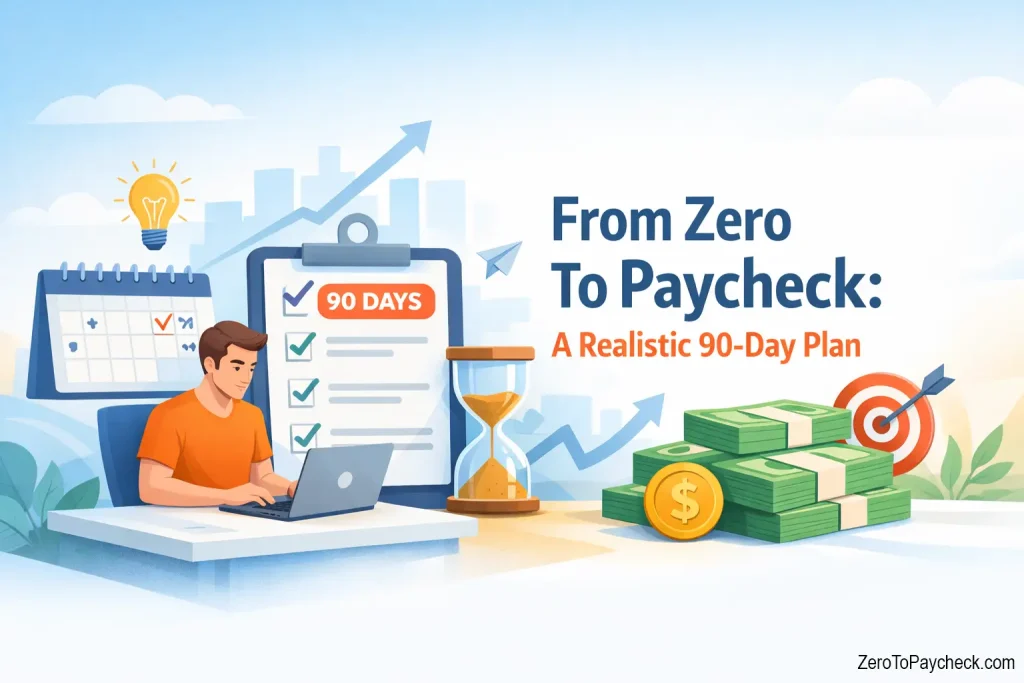
By the end of 90 days, if you follow this plan, you’ll have your first legitimate paycheck from online work. Maybe it’s $200. Maybe it’s $1,200. Almost certainly not $47,000. But it’ll be real, it’ll be yours, and more importantly, you’ll have the foundation to keep building.
That’s the promise. A real one.
| Quick Answer: What Is This 90-Day Plan? A structured, phase-by-phase roadmap that takes you from choosing a freelance skill (Week 1) through landing your first paying client (Week 5-8) to collecting your first paycheck and building a sustainable pipeline (Week 9-12). It focuses on active income first — the fastest path to getting paid — before exploring passive income strategies later. |
You might be skeptical about the timing. Fair enough. But here’s a data point worth knowing: according to Upwork’s Freelance Forward report, more than 64 million Americans did freelance work in a recent year — contributing approximately $1.27 trillion to the U.S. economy. That’s not a niche anymore. That’s a massive, mainstream labor market.
Remote work didn’t just survive the pandemic — it fundamentally restructured how businesses think about talent. Small businesses and startups especially can’t afford full-time employees for every need. They hire freelancers for writing, social media management, customer support, data entry, graphic design, bookkeeping, and a hundred other tasks. They need people exactly like you.
And here’s the thing that surprised me most when I first started freelancing: it wasn’t the actual work that was hard. It was finding the work. But once you understand how to position yourself and where to look — which is exactly what this plan covers — the actual skills required for most beginner-friendly roles are things you can learn in a few weeks.
The opportunity is real. The question is whether you’re willing to approach it like a professional instead of a lottery ticket.
“Find your passion first.”
You’ve heard this a hundred times. It sounds wise and inspiring. It’s also, in my experience, one of the biggest traps beginners fall into.
Spending weeks trying to “discover your passion” before taking any action is just procrastination with better PR. The truth? Passion follows momentum, not the other way around. Nobody is passionate about virtual assisting before they’ve done it. But a lot of people discover they genuinely enjoy the problem-solving, the client relationships, and the flexibility — after they’ve started.
What you actually need to find first is a problem to solve or a service to provide. Find something a business needs and will pay for. Start there. The passion, if it comes, will follow.
(A friend of mine spent three months agonizing over whether her “true passion” was photography or travel writing. Meanwhile she wasn’t earning a dime. She finally picked social media content creation because a local gym needed help — not because it was her calling. Six months later she’d replaced her salary and quit her 9-to-5. Her passion came from the success, not the other way around.)
This phase is entirely about setup. You’re not getting paid yet. That’s okay. Rushing straight to pitching clients without a clear skill or even a basic portfolio is like showing up to a job interview without a resume. The work you do in these four weeks is what makes everything else possible.
You need to pick ONE thing to offer. Not three. Not five. One. The biggest mistake beginners make is trying to offer everything and standing for nothing.
The best beginner skills share a few characteristics: businesses actively need them, they don’t require years of training to do at an acceptable level, and you can demonstrate your capability fairly quickly. Here are the most reliable entry points:
Honest take: if you’re a decent writer and can produce clear, grammatically correct prose, freelance writing is one of the fastest paths to a first paycheck. It’s not glamorous. Plenty of the work is writing product descriptions or listicles. But it pays, it’s always needed, and you can get better fast.
If writing isn’t your thing, virtual assisting is the other great entry point. If you’re organized, reliable, and good at communication, you’re already most of the way there.
A portfolio doesn’t mean you need paid work experience. It means you need samples. Here’s how you create them from scratch:
For writers: Write three sample articles on topics in a niche you want to serve. Publish them on a free Medium or Substack account — just so they have a live URL you can point to.
For virtual assistants: Create a one-page document outlining your services, your availability, and your tools (Google Workspace, Slack, Trello, Zoom, etc.).
For social media managers: Create three sample content packages for a fictional business using Canva — show what a week of posts would look like.
For graphic designers: Design five to ten samples in Canva across different industries. A social banner, a flyer, a simple logo concept.
This is your portfolio. Three to five pieces of work. You don’t need a fancy website for now — a Google Drive folder with a shareable link is completely sufficient for the first 90 days.
(What is a portfolio? It’s simply a collection of your work samples that demonstrates what you can do. Think of it as a taste test. You’re showing potential clients the quality they can expect from you.)
Two things only. Don’t overcomplicate this.
LinkedIn: Update your headline to something like “Freelance Content Writer | Helping small businesses tell their story” or “Virtual Assistant | Supporting busy entrepreneurs with administrative tasks.” Fill in your summary section, add your location, and list your skills. That’s it. It doesn’t need to be perfect — it needs to exist.
Upwork profile: Create a free account on Upwork. Fill out the profile completely — every section. This is critical because Upwork’s algorithm buries incomplete profiles. Use your portfolio samples as your work history. Write a clear, specific headline and overview that speaks directly to the type of client you want to serve.
You’re also going to need a PayPal account (or a bank account linked to a payment processor like Stripe) to actually receive money. Get this sorted in Week 1 so there’s no friction when your first client wants to pay you.
| Week 4 Reality Check At the end of Phase 1, you have: a chosen skill, 3-5 portfolio samples, a LinkedIn profile, an Upwork profile, and a payment method. You have NOT been paid yet. That is completely normal. The foundation is laid. Phase 2 is where things get real. |
This is the phase most people give up on. And it’s not because the work is hard — it’s because rejection is uncomfortable, and the early days involve a lot of silence where you expected responses.
Let me save you the frustration: getting your first client is almost entirely a numbers game filtered through quality. You need to send enough outreach, targeted correctly, with a message that’s actually about the client rather than about you.
Start with these three channels, in this order:
I know. It feels awkward. Tell me anyway.
Post on your personal Facebook or LinkedIn: “Hey, I’m offering [your service] to small businesses. If you know anyone who might need help with [specific problem], I’d love an introduction.” Send direct messages to people who own small businesses. Reach out to former coworkers who’ve started their own thing.
Most people who figure out how to make money online without a huge following do it first through their existing network. It’s not sexy. It works.
Upwork is the most beginner-accessible major freelance platform. Yes, there’s competition. Yes, you’ll be bidding against people with more reviews than you. Here’s how you handle that:
Here’s a proposal template that actually works:
| Sample Upwork Proposal Template Hi [Client Name], I noticed you need help with [specific task they mentioned]. I’ve done similar work — [one-sentence evidence, even if it’s a spec sample] — and I think I can get you exactly what you’re looking for. Here’s how I’d approach this: [1-2 specific sentences about HOW you’d do the work, not just that you can do it.] I’m happy to do a small test task so you can see my quality before committing. What questions do you have? [Your name] |
This is slower but can lead to better-paying, longer-term relationships. Find small businesses in a niche (restaurants, local service businesses, small e-commerce stores) and look at their social media, website, or marketing materials. If you spot an obvious gap — their Instagram hasn’t been posted to in three months, their website copy is full of errors — reach out and mention specifically what you noticed.
This approach feels like a lot of work. But talking with other freelancers, they consistently point to direct outreach as the source of their best early clients. It shows initiative. It shows you’ve done your homework. Most people simply don’t do it.
Here’s the hard truth about your first client: you may have to take less money than you’re worth. That’s not a permanent state — it’s a strategic investment.
Your goal for the first job isn’t maximum pay. It’s a finished project, a happy client, and a testimonial. A five-star review on Upwork or a written endorsement from a real client is worth more to a beginner than $50 extra on one job.
Set your initial rates conservatively:
After you have two or three completed jobs and good reviews, you start raising rates. That’s Phase 3 territory.
Also — and this matters — learn to recognize scams. If a client on any platform asks you to pay money upfront to “secure” a job, buy equipment, or access a training system, stop immediately. That is a scam, full stop. No legitimate employer will ever ask you to pay them.
| Week 8 Reality Check: What to Expect Financially Realistic income by end of Week 8: $0 to $500. That’s not a typo. Many people don’t land their first client until Week 6 or 7. Some get lucky in Week 5. A few go to Week 9. The timeline varies, but the pattern is consistent: outreach starts slow, then compounds. Don’t interpret early silence as failure. |
This is where it gets genuinely exciting. You’ve done the unsexy work. You’ve built the foundation. You’ve done the outreach. And now — hopefully — you’ve got at least one client and some real work in progress.
Phase 3 is about two things: delivering excellent work that generates testimonials and referrals, and building the simple systems that keep clients coming and payments flowing consistently.
The easiest way to get your second client is to impress your first one.
A few things that separate the freelancers who build careers from the ones who fizzle:
(A scope of work, by the way, is just a clear agreement about what you will and won’t deliver. Before starting any project, confirm in writing: what you’re making, how many revisions are included, and when it’s due. This protects both of you.)
When your first payment comes in, it’ll feel amazing. Let that feeling sink in for a moment. Then set aside 20-30% of it.
Here’s the thing most beginners don’t realize until it’s too late: as a freelancer, you’re running a small business. That means when tax season comes, there’s no employer withholding taxes for you. If you earn more than $600 from a single client in the U.S., they’ll likely send you a 1099 tax form. You’re responsible for paying self-employment tax on that income.
The simple fix: open a separate savings account, label it “Taxes,” and move 25% of every payment into it immediately. You’ll thank yourself in April.
For payment terms, use written agreements with simple payment milestones: 50% upfront for new clients (this is standard and protects you), and 50% on completion. Use PayPal, Stripe, or whichever platform you’ve set up. Get it in writing before you start work.
Do this. It feels awkward. It changes everything.
After you’ve successfully delivered a project, send this message:
| Testimonial Request Template “Hi [Name], I really enjoyed working on this project with you. It would mean a lot to me if you could share a short testimonial about your experience — even 2-3 sentences about what you found most useful. I’m building my portfolio and your feedback would really help. Happy to return the favor in any way I can!” |
Post those testimonials on your LinkedIn, your Upwork profile, and that Google Drive portfolio folder. They’re your proof. Every time you get a new one, your conversion rate on future client outreach improves.
Here’s a simple weekly system that keeps work coming:
Consistent outreach — even when you have work — is what keeps you from the feast-or-famine cycle that kills most freelance businesses before they get going. The professionals I know who do this consistently never have dry months. Beginners who only prospect when they’re desperate always do.
You don’t need to spend money to start. Here’s what actually matters:
That’s the whole toolkit. Anything beyond this is an upgrade you can make later when you’re actually earning. Resist the urge to spend money on “business tools” before you have revenue.
Your portfolio doesn’t need to be perfect. Your Upwork profile doesn’t need to be perfect. Your first proposal doesn’t need to be perfect. Done and sent beats perfect and waiting every single time. You will improve by doing, not by planning to do.
One skill. One platform. One niche (if possible). At least for the first 90 days. The temptation to be on Upwork AND Fiverr AND direct outreach AND a blog AND a YouTube channel is real and it will dilute everything you’re doing. Focus wins.
Starting low is strategy. Staying low is a mistake. After your first three completed projects and solid reviews, raise your rates by 20-30%. Do this again after your next five. Your skills and your reputation are both growing — your prices should reflect that.
I said it before and I’ll say it again because it’s genuinely painful when people ignore it: set aside 20-30% for taxes from day one. It’s not exciting advice. It’s the advice that keeps you from a nasty surprise.
I touched on this earlier, but let me be direct: the “make money online” space is full of predators specifically targeting people in financial stress. Red flags include any of the following:
If something feels off, it probably is. Trust your gut, and when in doubt, search “[company name] scam” before engaging.
Let’s talk specifics, because most “make money online” articles deliberately stay vague here.
| Timeframe | Realistic Earnings | What You’re Doing |
| End of Month 1 | $0 (most people) | Building foundation, no clients yet |
| End of Month 2 | $50 – $500 | First 1-3 small clients, building reviews |
| End of Month 3 | $300 – $1,500 | Repeat clients, testimonials, raising rates |
Disclaimer: These are realistic ranges based on patterns I’ve observed, not guarantees. Your results will depend on your skill, your consistency, your niche, your market, and dozens of factors outside this plan’s control. Some people do better. Some take longer. The point is to set your expectations on reality, not YouTube thumbnails.
You have more than you think. Have you managed a household? You’re organized and can handle multiple priorities — that’s virtual assisting. Have you ever explained something complicated to someone? You can write. Have you used social media for years? You understand platforms intuitively in a way many small business owners don’t.
But let’s say you truly feel unequipped. Pick one beginner-friendly skill from the list in Phase 1 and dedicate four weeks to learning it through free resources (YouTube, Google’s Skillshop, HubSpot Academy, Coursera’s free courses). Four focused weeks is enough to reach a competent beginner level in writing, social media, or virtual assisting.
Great question — and the right one to ask. The difference is simple: legitimate freelance work involves you getting paid to do real work for real clients. Nobody asks you to pay them anything. Nobody promises you impossible returns. You work, you deliver, you get paid. That’s it.
Scams involve upfront payments, vague “opportunities,” elaborate recruitment structures, or income that depends primarily on recruiting others. If any of those elements appear, walk away.
For the first 90 days, almost certainly not. You can legally earn freelance income as an individual in most countries without registering a formal business entity. In the U.S., you’d operate as a “sole proprietor” by default — no registration required.
Once you’re earning consistently (let’s say $1,000+ per month), it’s worth having a conversation with an accountant about whether an LLC makes sense for liability protection and potential tax advantages. But that’s a Month 6 problem, not a Day 1 problem.
Absolutely — and honestly, that’s the recommended approach. The 90-day plan assumes 10-15 hours per week. If you can carve out evenings and weekends, you can run this completely alongside existing employment. Many people build their freelance income to a level that exceeds their salary before ever considering leaving their job. That’s the smart play.
You keep going. But now you have something you didn’t have before: proof. Proof that you can do the work, proof that clients will pay you for it, and proof of what your income potential looks like. The next phase (Months 4-6) involves raising your rates, potentially narrowing your niche, building a simple website, and starting to think about whether passive income streams — digital products, courses, templates — make sense to layer on top of your active income.
[Link to our guide: “How to Scale Your Freelance Business from $500 to $5,000 a Month”]
Here’s the part where I’m supposed to leave you feeling inspired and ready to conquer the internet.
Instead, let me tell you the thing that will actually help you most.
The 90-day plan works. The framework is sound. The tools are real. The opportunities are legitimate.
But it only works if you do. And I don’t mean “if you work hard” in some vague motivational poster sense. I mean: it works if you actually open Upwork and create the profile today. If you actually write those three sample articles this week. If you actually send ten proposals before you feel ready.
The gap between people who figure out how to make money online and people who don’t isn’t talent, education, or luck. It’s execution. Specifically, the willingness to be a beginner in public — to send a proposal when your profile has zero reviews, to share work you know isn’t your best yet, to follow up on a message that went unanswered.
Finding your first client is like sending out a dozen fishing lines. You just need one good bite to start. But you have to actually put the lines in the water.
So. Start Week 1 today. Not Monday. Today.
Pick your skill. Start your portfolio. Create the profile. The paycheck is on the other side of the work you’re about to do.
Disclaimer: Income results vary significantly based on individual effort, skill level, market conditions, and many other factors. The figures cited in this article represent realistic ranges observed across the freelance community and are not guarantees of earnings. This article is for informational purposes only and does not constitute financial or legal advice. Please consult a qualified professional for tax and legal questions specific to your situation.