Physical Address
304 North Cardinal St.
Dorchester Center, MA 02124
Physical Address
304 North Cardinal St.
Dorchester Center, MA 02124
A practical, no-fluff guide for skeptical beginners who just want proof this whole ‘online money’ thing is real
You know that specific feeling. You’re sitting at your laptop at 11pm, three tabs open — some YouTube video promising ‘passive income,’ a Reddit thread full of contradictions, and a Google search that’s returned the same recycled list of ‘take surveys to make money’ articles for the last decade. You want to believe it’s real. But you’ve been burned before, or you know someone who has, and the skepticism is so thick you can almost taste it.
Here’s what I want to say right at the start: that skepticism is healthy. It means you’re paying attention. The internet is genuinely full of garbage when it comes to ‘make money online’ content — vague advice, unrealistic promises, and methods that quietly disappeared three years ago. So let’s agree on something before we go any further.
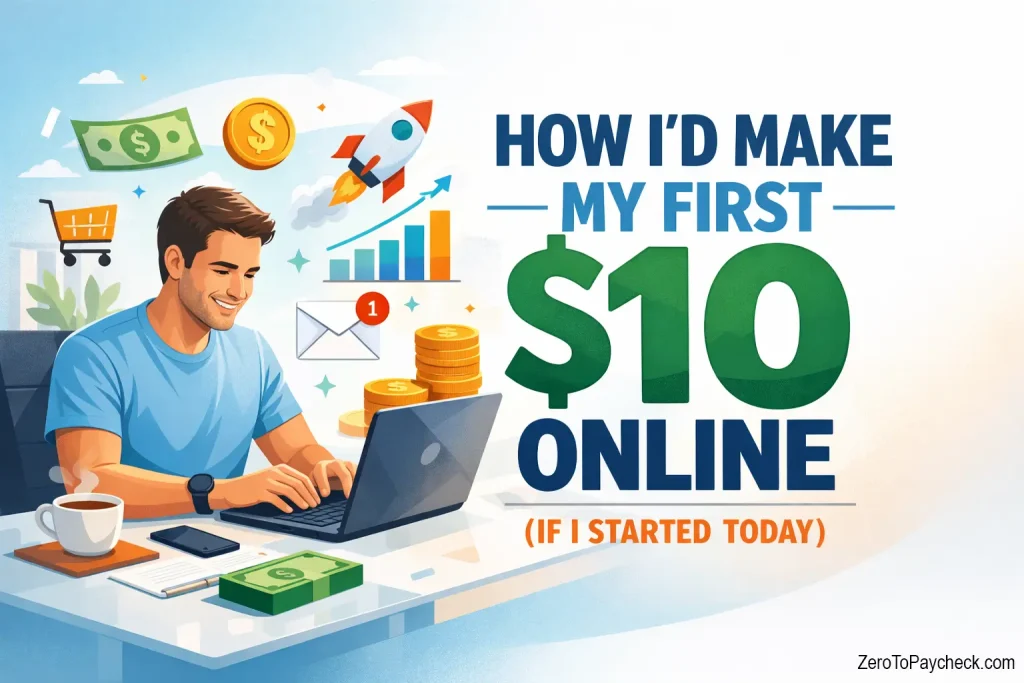
| The goal of this article isn’t to make you rich. It’s to help you make your first $10 online — a real $10 that lands in a real account like PayPal or your bank. Once that happens, everything changes. Because now it’s not theoretical. Now it’s a skill. |
I’ve spent more than two decades covering business, technology, and the evolving gig economy for publications like The Atlantic and Wired. I’ve also been on the other side of it — building my own online income streams, making every rookie mistake in the book, and watching the ecosystem shift from early-days eBay flipping to the sophisticated creator economy we have today.
What I know for certain is this: the first $10 is harder than the next $100. Not because it’s more technically difficult. Because it requires you to break through a psychological wall that nobody warns you about. We’re going to talk about that wall. And then we’re going to knock it down.
I want to give you some context here, because I think it matters. We’re living through a genuinely unusual moment in the history of work.
According to a 2024 report from Upwork, over 64 million Americans freelanced in the past year — that’s 38% of the workforce. The global gig economy is projected to reach $455 billion by 2025, according to Mastercard Economics Institute. And Fiverr has reported that some of its fastest-growing service categories involve skills that didn’t exist as formal jobs ten years ago: AI prompt engineering, podcast editing, social media content strategy.
None of this is a get-rich-quick pitch. It’s context. The infrastructure for making money online has never been more accessible, more legitimate, or more diverse. PayPal, Stripe, Venmo, and direct bank transfers mean that getting paid is genuinely instant and global. Platforms like Upwork and Fiverr have built trust mechanisms that protect buyers and sellers both. Etsy has made it possible for someone in a small town to sell digital downloads to a customer in Tokyo without ever meeting them.
The barriers that existed in 2005 — needing your own website, handling your own payment processing, figuring out shipping — have largely been removed. What’s left is mostly mindset. Which brings me to the thing I wish someone had told me.
| Quick Insight: The biggest obstacle to making your first $10 online isn’t skill, technology, or time. It’s the belief that you need to be ‘ready.’ You don’t. Readiness is a myth people use to avoid the discomfort of starting. |
I see this pattern constantly. Someone wants to make money online, so they spend three weeks ‘researching.’ They read 40 articles. They watch 20 YouTube videos. They buy a course. They design a logo for their ‘brand.’ They think about their niche. They create a spreadsheet of methods. They set up a home office.
And they make exactly zero dollars.
Here’s the thing — over-preparation is the enemy of that first $10. It feels productive. It’s not. It’s a sophisticated form of procrastination that your brain uses to protect you from the risk of failure. Because if you never actually try, you can never actually fail. You can just keep researching.
The people I’ve spoken with who made their first money online fastest share one trait: they started embarrassingly small and embarrassingly fast. One friend — a graphic designer — told me she made her first $5 from an online marketplace before she even had a proper portfolio. ‘I just put up one thing I’d made for free,’ she said, ‘and someone bought it while I was at the grocery store.’ That moment — seeing that $5 notification — changed everything for her. Not because of the money, but because of the proof.
You don’t need a business plan. You don’t need a perfect website. You don’t need to be the best in the world at anything. You need to make that first transaction happen, even if it’s imperfect, so that your brain can stop treating this as a hypothetical.
| What this is: Getting paid for small, defined tasks — answering surveys, testing websites, transcribing audio, or reviewing apps. No portfolio, no pitching, no experience required. |
Let me be honest with you about this category: some of it is a grind, and not everything pays fairly. I wasted an embarrassing amount of time in my early days on survey sites that paid $0.50 for 45 minutes of my life. Don’t do that to yourself. Here’s the curated version of what actually works for a first $10.
This is my top pick for speed and legitimacy. Platforms like UserTesting, TryMyUI, and Userlytics pay you to test websites and apps. You simply use a product while narrating your thoughts — essentially telling a company what’s confusing or broken about their digital experience. A typical test takes 15–20 minutes and pays $10 on UserTesting. That’s your first $10, right there. Often in the same day you sign up.
Prolific Academic is another excellent option — it runs legitimate academic research studies and pays notably better than traditional survey sites. Researchers at universities need real humans for data. That human can be you.
One genuine warning: be skeptical of any micro-task platform that asks you to pay a fee to access jobs. Legitimate platforms — UserTesting, Prolific, Appen — will never ask you to pay to participate. That’s a scam, full stop.
| Platform | Avg Pay | Time to First $10 | Payout Method |
| UserTesting | $10 per test | Same day (1 test) | PayPal |
| Prolific | ~$9–12/hr equiv. | 1–3 days | PayPal / Circle |
| Appen | Varies by project | 3–7 days | PayPal |
| What this is: Creating a simple digital product once — a template, a printable, a checklist — and selling it repeatedly. Even to 10 buyers at $1 each, that’s your first $10. |
Here’s what surprised me when I first tried this: the moment I made that first $8 sale on Etsy at 2am on a Tuesday — without doing anything, while I was asleep — something clicked in my brain that no amount of reading about ‘passive income’ had managed to trigger. The internet genuinely is a machine that moves money from people with problems to people with solutions. That first sale proved it.
The ‘sell what you have’ approach works because digital products are infinitely scalable with zero inventory. Once you create the file, you can sell it forever. The barrier to entry is also genuinely low. You don’t need Photoshop — free tools like Canva let you create professional-looking designs in hours.
Where to sell your first digital product:
(A word of caution here: don’t try to compete on Etsy in massively saturated categories right away. If you search ‘wedding invitation template’ and see 50,000 results, you’ll be invisible. Search for something more specific — ‘minimalist teacher planner 2025’ — and you’ll find smaller but more reachable pockets of demand.)
| What this is: Finding one person who needs help with something you already know how to do, and doing it for them in exchange for money. The simplest business model in the world. |
I know what you’re thinking. ‘I don’t have any marketable skills.’ I hear this constantly — from engineers who don’t think ‘technical writing’ counts, from teachers who don’t realize ‘curriculum design’ is a consulting category, from stay-at-home parents who don’t recognize that ‘research and scheduling’ is a legitimate virtual assistant service. You have more skills than you think. The question is just which ones translate to online services.
In my experience, the fastest route to a first freelancing dollar involves one of three categories:
Can you write a clear email? Explain something complicated in plain language? Proofread without introducing errors? You can charge for this. Businesses desperately need content — blog posts, product descriptions, email newsletters. Even basic, competent writing earns $10–25 per piece for entry-level work. Platforms like Fiverr, Upwork, and PeoplePerHour are where to start. A simple ‘I will write a 500-word blog post’ gig on Fiverr has worked for countless beginners.
This is the most underrated beginner freelance category. Scheduling, inbox management, data entry, research tasks, social media scheduling — companies and busy professionals pay $10–20 per hour for reliable help with these tasks. No degree required. No portfolio required. Just organization and reliability.
Canva has made this legitimately accessible to non-designers. Small businesses need social media graphics, simple logos, flyers, and presentations. If you can put together something that looks cleaner than what they have, you can charge for it. Don’t oversell yourself as a ‘professional graphic designer’ if you’re not — but ‘social media graphics via Canva’ is a completely honest and legitimate service.
The key with freelancing for that first $10? Don’t build an elaborate profile first. Put up one service, one basic description, one low price point (even $5–10 to start), and get your first review. That review is worth more than any fancy profile. Treat it as a proof-of-concept phase, not a career launch.
| Method | Time to $10 | Skill Needed | Best Platform |
| Micro-tasks | Same day | None | Prolific / UserTesting |
| Sell digital items | 1–3 days | Basic design | Etsy / Gumroad |
| Freelance service | 2–5 days | Any skill | Fiverr / Upwork |
Okay, let’s get concrete. Here’s a literal step-by-step for the fastest path to your first $10 — the user testing route, because it has the lowest barrier and the highest speed.
| Realistic Timeline: UserTesting payment = within 1 week. Gumroad digital product sale = anywhere from day 1 to 2 weeks, depending on how you promote it. First $10 combined? Most people see it within 5–10 days if they actually do both. |
I’ve watched a lot of people start this journey, including myself. Here’s the condensed list of what goes wrong, and how to avoid it.
It’s not coming. Done is better than perfect, always, especially in your proof-of-concept phase. Your first Fiverr gig doesn’t need to be beautiful. Your first digital product doesn’t need to be comprehensive. It needs to exist.
Pick one method. Commit to getting your first $10 from it. Then diversify. Trying to do user testing AND freelancing AND digital products AND dropshipping simultaneously is a recipe for doing all of them badly.
Making money online triggers something weird in the brain. There’s a dopamine-driven reward loop that activates with that first payment notification — but fear of failure often blocks people from even getting there. Recognize that the discomfort you feel before starting is normal, expected, and not a sign that you’re about to fail.
Red flags for online money-making scams: any platform asking you to pay upfront to access work. Any ‘job’ that requires you to buy a product first. Any ‘passive income system’ being sold for $297. Any promise of specific income amounts (‘Make $500 a day with this trick!’). Legitimate platforms like Upwork, Fiverr, and UserTesting do not cost money to join or participate.
Technically, yes — you need to report this income. In the US, if you earn more than $600 from a single platform, you’ll receive a 1099 form. Even below that threshold, the IRS expects you to report income. This isn’t a reason to avoid making money online — it’s just a reason to keep simple records. A spreadsheet with dates and amounts is all you need at the beginning. Consult a tax professional as your income grows.
I asked a few people I know who made their first dollar online what that moment felt like. The answers were remarkably similar:
‘It felt fake at first. I kept checking to make sure it was real money.’
‘I literally told my wife immediately. She didn’t get why I was so excited about ten dollars. But I knew what it meant.’
‘I spent it on a nice coffee and thought about it the whole time. It wasn’t about the money — it was about the fact that a stranger on the internet had decided my work was worth paying for.’
That last quote captures something important. The first $10 is proof. It’s permission. It tells your brain: this isn’t a scam, this isn’t theoretical, this is a real skill that real people pay for. And once you have that proof, scaling from $10 to $100 to $1,000 becomes a matter of repetition, not magic.
What I’ve personally found is that most people who make their first $10 online go on to make their first $100 within 30 days — if they keep going. The dropout rate isn’t due to lack of opportunity. It’s due to impatience and stopping just before the traction starts.
| Important Disclaimer: Results vary significantly based on effort, location, skill level, time invested, and market conditions. Nothing in this article constitutes financial advice. Income figures mentioned are illustrative averages and are not guarantees. |
No. You can operate as a sole proprietor — just your own name — to start. Setting up an LLC is a future consideration when and if your income grows to a point where it makes sense. Don’t let the business formation question stop you from making your first $10.
Several platforms now support direct bank transfers (Appen, some user testing platforms) or Payoneer as an alternative to PayPal. Stripe is another option for digital product sellers. The PayPal requirement used to be more rigid — that’s changing as the ecosystem matures.
Honestly — with UserTesting specifically, you can have $10 pending in your account within the same day if you sign up in the morning and a qualifying test becomes available. Other methods range from a few days (digital products if you share them actively) to a couple of weeks (freelancing, which requires some profile-building time).
The platforms mentioned in this article — UserTesting, Prolific, Fiverr, Upwork, Etsy, Gumroad, Appen — are all established, publicly traded or well-funded companies with verifiable track records. They are legitimate. The gig economy has matured significantly. Stick to known platforms, and you’ll be fine. The warning signs to watch for are mentioned above in the ‘Common Mistakes’ section.
Honestly, the most common reason is starting too many things and finishing none of them. Pick one method. Set a specific goal (one UserTesting test, or one digital product listing, or one Fiverr gig). Do nothing else until that goal is complete. Then assess. A good friend of mine attempted freelancing for two months before making anything, because she kept rebuilding her profile instead of actually delivering work. The second she sent five cold pitches in one day, she had her first project by the weekend.
If this article has been useful, here are some natural next steps to explore on this site:
Remember where we started — that late-night anxiety, the open tabs, the skepticism that’s equal parts self-protection and frustration. That feeling is real. And it doesn’t go away with more research or more preparation. It only goes away when you make something happen.
Treat your first $10 like kindling for a fire. You don’t need a roaring blaze yet. You just need a spark — one transaction, one proof, one moment when a stranger on the internet decides your work or your time is worth paying for.
The methods in this article aren’t theoretical. They’re not passive-income fantasies dressed up in a blog post. They’re the things I would do if I woke up tomorrow with nothing but a laptop and an internet connection and needed to prove to myself that this online money thing is real.
UserTesting, Prolific, Etsy, Gumroad, Fiverr, Upwork — these platforms exist, they’re legitimate, and people are making real money on them right now. The only question is whether you’ll be one of them.
Start today. Not tomorrow. Not after you’ve finished your research. Today.
The $10 is waiting.
─────────────────────────────────────────────────────────────────
Disclaimer: Income results vary widely based on individual effort, experience, location, and market conditions. Nothing in this article constitutes financial, legal, or tax advice. Consult qualified professionals regarding your specific situation. All platform features and payment amounts are subject to change.