Physical Address
304 North Cardinal St.
Dorchester Center, MA 02124
Physical Address
304 North Cardinal St.
Dorchester Center, MA 02124
The Side Hustle Brief — Real tactics from someone who’s actually done it.
No Lamborghini promises. No ‘secret system.’ Just three paths that actually work — from someone who’s built and sold online businesses, and failed spectacularly at one.
You know that specific kind of dread? The one where you check your bank balance right before a bill hits — and the numbers don’t quite work. Maybe it’s a car repair. Maybe it’s credit card interest quietly eating your paycheck. Or maybe you just realized that inflation has made your ‘comfortable’ salary feel anything but.
I’ve been there. Not as a thought experiment — as a lived experience, sitting in a coffee shop in 2011, watching my savings account tick down while my first online business limped along. That business eventually worked. But before it did, I wasted three months and $400 on a dropshipping course that taught me absolutely nothing I couldn’t have found for free on YouTube in an afternoon. Don’t be me.
Here’s what I’ve learned after two decades of building things online: most ‘make money online‘ advice is designed to make money for the person writing it, not you. It’s vague, aspirational, and suspiciously light on the actual mechanics. This guide is different. It’s specific. It’s honest about timelines. And it focuses on something achievable — $50 a day — rather than dangling some fantasy income number to keep you clicking.
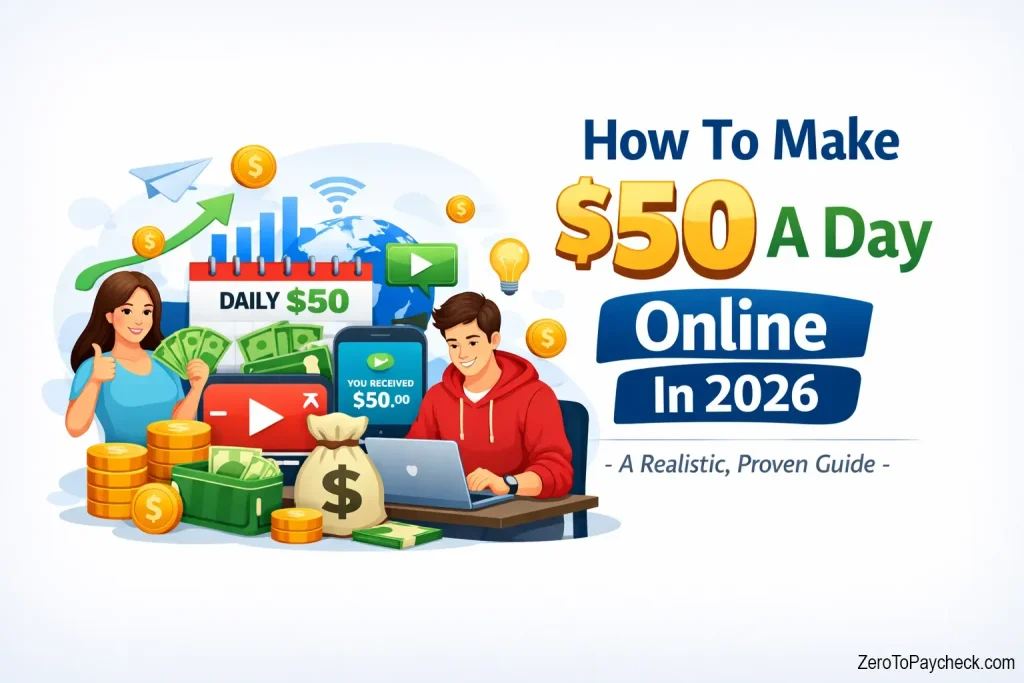
$50 a day is $1,500 a month. That’s a car payment gone. A credit card knocked down. Breathing room. For a lot of people reading this, that number would genuinely change their lives.
| WHAT YOU’LL LEARN IN THIS GUIDE
Three proven paths to your first $50 day (with step-by-step instructions), the exact free tools you need, a 30-day game plan, common traps to avoid, and a blunt section on spotting scams. No fluff. No filler. |
| DISCLAIMER
Results vary based on your effort, skill level, and market conditions. The income figures in this article represent realistic outcomes for people who follow through — not guaranteed numbers. Online income is subject to self-employment taxes (more on that below). |
Let me be straight with you about the psychology here. Why $50 and not $500? Because $50 a day is genuinely achievable within 30–90 days for a committed beginner. $500 a day is a real target too — but it requires either significant skill, capital, or time. Starting with $500 as your goal is a setup for discouragement. Starting with $50 is a setup for a win that builds momentum for the next one.
| THE MATH THAT MAKES $50 A DAY WORTH PURSUING
$1,500/month at $50/day (30 days) — enough to eliminate a car payment or crush a minimum credit card balance $18,000/year what $50/day compounds to annually — a real second income, not a side note +22% gig growth Bureau of Labor Statistics projects 22% growth in freelance and contract roles through 2028 |
And about timing: 2026 is arguably the best environment ever for someone starting an online income stream. The gig economy isn’t shrinking — it’s professionalizing. According to a 2024 Pew Research study, 45% of side hustlers say they need the extra income to meet basic needs, which means the demand for affordable services is enormous. Freelance platforms like Upwork have reported year-over-year growth in project postings. The rise of AI tools like Canva’s AI features has dramatically lowered the barrier to entry for creators and service providers.
Inflation has also done something unexpected: it’s made people more willing to pay for solutions. When your budget is tight, you pay someone to do things faster. That’s an opportunity if you’re the person solving the problem.
Who is this guide perfect for? People with 1–3 hours of daily free time, a computer and internet connection, and the willingness to follow through consistently for at least 30 days. Who is it not for? People looking for genuinely passive income with zero work up front. Everything in this guide requires real effort — especially at the start.
I’m going to give you three paths, not twenty. Twenty paths is how ‘make money online‘ listicles bury you in options and guarantee you do nothing. Three paths is a choice. Pick one. Start there.
| Method | Type | Startup Cost | Time to $50/day | Ceiling |
| Freelancing (Writing, Design, Admin) | Active income | $0 | 1–4 weeks | High ($100–500+/day) |
| Digital Products (Templates, Ebooks) | Passive / hybrid | $0–$15 | 2–8 weeks | Very high (scalable) |
| Print-on-Demand (Merch, Niche Art) | Hybrid / passive | $0 | 4–12 weeks | Medium ($50–200/day) |
Freelancing is still the fastest path from zero to $50 in a single day. I know that sounds boring. It isn’t. Here’s why: you’re trading skill for money, and the current market is paying generously for skills you probably already have or can develop in a few weeks.
Freelance writers I know are currently commanding $0.50–$1.00 per word on platforms like Contra and direct client work. A 500-word blog post at $0.75/word is $375. That’s a $375 day — and it’s not unusual. Virtual assistants are charging $25–45 per hour for inbox management and scheduling work that requires no technical background. Graphic designers using Canva are landing $150–300 per project on social media templates.
Here’s the thing though — and this is where I made my worst early mistake. When I first started freelancing, I priced myself at $5 for a 1,000-word article because I thought that’s what it took to compete. I worked myself ragged for $15 a day and burned out in three weeks. Don’t undercharge. The $5 clients are the worst clients. Price yourself fairly from day one.
IN-DEMAND FREELANCE SKILLS FOR 2026:
STEP-BY-STEP: LANDING YOUR FIRST FREELANCE CLIENT
| STEP 1 OF 5
Choose your service and define your offer Pick one thing you can do better than average. ‘I write email newsletters for SaaS companies’ is 10x more marketable than ‘I’m a writer.’ Specificity commands higher rates. |
| STEP 2 OF 5
Set up your profile on 1–2 platforms Upwork for higher-value projects, Contra for no-fee direct hiring, Fiverr for quick-win gigs. Don’t spread yourself across all of them. Focus. |
| STEP 3 OF 5
Build a 3-piece portfolio (even spec work) No experience? Write three sample blog posts, design three sample social graphics, or create a mock virtual assistant workflow. Upload them to a free Notion page or Carrd site. |
| STEP 4 OF 5
Send 5–10 tailored pitches per day Not copy-paste proposals. Read the job post, address the specific need, explain exactly how you’d solve it in 3 sentences. Most pitches are lazy — yours won’t be. |
| STEP 5 OF 5
Land your first client and overdeliver Your first client is a proof point. Treat them like gold. A good review on Upwork is worth 10 more proposals. A referral from a happy client is worth even more. |
What surprised me the most when I started freelancing seriously? How quickly a one-off gig turned into a retainer. A retainer is when a client pays you a fixed monthly fee — say, $800/month — to handle recurring work. Three retainer clients at $500/month each is $1,500 a month. Done. One friend of mine paid off her entire credit card debt in eight months on virtual assisting income. She started with zero experience and one client she found through a Facebook group.
Here’s my contrarian take on digital products: you don’t need an audience to sell a digital product. You just need to show up where your buyers already are. The standard advice is ‘build an audience first, then sell.’ That’s fine if you have 18 months to wait. For someone who needs $50 a day in 2026, it’s mostly useless.
What actually works is creating a specific product that solves a specific problem for a specific person, and then parking it where people are actively searching for that solution. Notion templates on Etsy. Canva social media packs on Gumroad. Budget spreadsheets on Payhip. Resume templates on Creative Market. These are real products that real people make $50–$500 a day selling — sometimes completely passively once the SEO kicks in.
The economics are beautiful. You create a template once. You list it for $15. You sell it 100 times. That’s $1,500 from one product. Now you have three products. You see where this goes.
| REAL EXAMPLE
A reader emailed after reading an earlier version of this guide. She’d created a $12 Notion freelancer CRM template — something she’d built for herself — and listed it on Gumroad with zero followers. Three months later she was making $400–600/month from it. She never ran an ad. People found it by Googling ‘Notion freelance tracker.’ |
BEST PLATFORMS FOR SELLING DIGITAL PRODUCTS
Let me have an honest conversation about traditional dropshipping first. The standard version — cheap products from AliExpress, a Shopify store, Facebook ads — has a real failure rate for beginners. The margins are thin, the ads are expensive, and you’re competing with thousands of identical stores. I tried it in 2018. I spent $600 on ads and made back $180. Lesson learned.
Print-on-demand is different, and here’s the twist that most guides miss: the money isn’t in generic designs. It’s in micro-niches.
Instead of making a generic ‘coffee lover’ mug, you make a mug for emergency room nurses from Georgia who love cats. That sounds absurdly niche. But that’s the point. The competition for ‘funny nurse mug’ on Redbubble is enormous. The competition for ‘ER nurse Georgia cat mom’ is approximately zero.
Platforms like Printful, Printify (integrates with Etsy and Shopify), and Redbubble let you upload designs, set your profit margin, and let them handle printing, shipping, and customer service. Your job is design and traffic. Canva’s free tier is more than enough to create compelling designs — no graphic design degree required.
Realistic timeline: your first sale might take 2–4 weeks. Consistent $50 days typically happen around months 2–4, after you’ve built a catalog of 50+ designs in 2–3 micro-niches. It’s slower than freelancing. But once it’s running, it genuinely doesn’t require your daily attention.
Short answer: less than you think. Here’s what you genuinely need to start any of the three paths above:
The one thing you might consider spending money on early? A domain name. At $12–15/year, having yourname.com gives you a level of credibility that free subdomains don’t. Optional — but worth it once you’re making your first $50.
| COURSES: A HARD NO (FOR NOW)
Do not pay for a course before you’ve made your first dollar. Everything you need to start is freely available on YouTube, Reddit’s r/freelance and r/digitalnomad communities, and the Upwork blog. Buy a course after you’ve validated the method and need to go deeper. Not before. |
Here’s where most guides stop giving you real direction. They tell you what to do, not when. This is a week-by-week breakdown — tight, specific, and doable even if you have a full-time job.
| WEEK 1 The Setup Sprint |
| – Day 1–2: Choose your path (one only). Define your offer or niche.
– Day 3–4: Create accounts on 1–2 platforms. Set up your portfolio page. – Day 5–7: Create 3 portfolio samples (even spec work). Zero ‘motivation content’ — just build. |
| WEEKS 2–3 The Outreach & Execution Phase |
| – Freelancers: Send 5–10 tailored pitches per day. Every day. No exceptions.
– Digital product makers: List your first product. Post it in 3 relevant Facebook groups or subreddits. – Print-on-demand: Upload 5 designs per day. Focus on one micro-niche. |
| WEEK 4 Review, Retool & Double Down |
| – Look at what’s getting traction (even a little). Do more of that.
– Identify what’s getting zero response. Change the framing, price, or target — not the whole strategy. – Set a specific goal for month 2 based on what you learned. |
| MONTH 2+ The Compounding Phase |
| – Ask your first client for a referral or retainer arrangement.
– Add a second digital product or design series. – Consider moving off platforms to direct clients — reclaim the fees. – Start tracking income for taxes. A simple spreadsheet works fine. |
I’ve watched hundreds of people start online businesses over the years. The ones who fail aren’t usually failing because of bad luck or a bad niche. They’re failing because of one of four very predictable, very preventable patterns.
Spending a week designing your logo. Rewriting your Upwork bio twelve times. Researching niches instead of picking one and starting. This isn’t preparation — it’s procrastination wearing a productivity costume.
Here’s a rule I give everyone who asks me about this: if you’ve been ‘setting up’ for more than 72 hours, you’re procrastinating. Ship something imperfect. Fix it later. The feedback from the market is 10x more valuable than any amount of preparation.
This one is lethal. You spend two weeks building a freelance profile. Then you watch a YouTube video about print-on-demand and it looks easier. You pivot. Two weeks later you see a TikTok about affiliate marketing. You pivot again.
Six months later you’ve built half of five things and finished none of them.
Pick one path. Work it for 60 days before evaluating. The grass always looks greener over the other side hustle.
This is the boring one, but it matters. Online income — whether through PayPal, Stripe, Gumroad, or Etsy — is taxable self-employment income. In the US, that typically means paying both income tax and self-employment tax (currently 15.3% on net earnings). You’ll likely need to pay quarterly estimated taxes once you’re earning consistently.
Keep a simple record of all income from day one. Set aside 25–30% of every payment in a separate account earmarked for taxes. A conversation with a CPA is worth it once you’re making $500+/month. Platforms like PayPal will send a 1099-K if you receive over $600 in a year — don’t let it surprise you.
| “Most people quit at week three. Week three is right before things start working.” |
I can’t prove this with data, but I’ve seen it too many times to ignore. Freelancers quit after 20 unanswered pitches — right before proposal 21 would have landed a $1,200 client. Digital product makers take down their Etsy shop after two weeks of zero sales — right before the SEO would have kicked in.
The psychology here is real and documented. Behavior research consistently shows people dramatically underestimate the time it takes to build momentum. Adjust your timeline expectations and you’ll stop quitting too soon. Give every serious attempt at least 60 focused days before deciding it ‘doesn’t work.’
Look, I get it. Half the stuff you read online about making money is designed to separate you from your money. This article is designed to help you make it. So let’s be direct about what to run from.
RUN FROM ANYTHING THAT DOES THESE THINGS:
| How long will it really take to reach $50 a day?
With focused effort — meaning 1–3 hours per day, seven days a week — most people on the freelancing path hit their first $50 day within 2–4 weeks. Digital products and print-on-demand typically take 6–12 weeks to reach consistent $50 days, because they depend on building a catalog and accumulating search visibility. The keyword is focused. Casual effort adds months to both timelines. |
| Do I need to buy a course first?
No. A hard no. The best free learning resources: YouTube (search ‘[your skill] freelancing tutorial 2026’), Reddit’s r/freelance, r/Etsy, r/WorkOnline, r/digitalnomad, the Upwork Resource Center, and Canva’s free design school. Spend money on a course only after you’ve made money and hit a specific ceiling you need help breaking through. |
| What’s the tax situation for this kind of income?
In the United States, online income is self-employment income. You’ll owe both income tax and self-employment tax (15.3% on net earnings). Once you’re consistently earning, you’ll likely need to file quarterly estimated tax payments (IRS Form 1040-ES). Keep records of all income and deductible business expenses. Consult a tax professional or CPA — it’s money well spent once you’re earning consistently. |
| I have a full-time job. Do I have time for this?
Yes — but be honest with yourself about the hours. One hour before work and one hour after work is realistically enough to launch a freelance business or a digital product. The 30-day plan in this guide is designed for exactly that scenario. What it requires is consistency, not volume. Sending five pitches a day for 30 days beats sending 150 pitches in one frantic weekend. |
| What if I’m not good at anything?
You are good at something. But if you feel stuck, here’s a reframe: instead of asking ‘what skill do I have?’ ask ‘what problem do I understand?’ Do you understand the chaos of running a small business’s inbox? That’s virtual assisting. Do you understand what it’s like to move to a new city? That’s an ebook or Notion guide. The skill is often less important than the specific context you bring to it. |
| Is affiliate marketing a good option for beginners?
It can be — but it’s harder for total beginners than most affiliate marketing content admits. Affiliate marketing usually requires an existing audience or strong SEO. If you have a blog, YouTube channel, or social media following, it’s absolutely worth layering in. As a first income source from scratch, the ramp-up time is significant. Build one of the three primary paths first, then add affiliate links as a passive supplement once you have traffic. |
Let’s come back to where we started. That feeling of checking your bank balance and finding it short. That low-grade financial anxiety that makes every unexpected expense feel like a small crisis. The quiet knowledge that your current situation isn’t sustainable.
$50 a day won’t fix everything. But $1,500 a month of additional income — on top of your regular earnings — creates real margin. Real options. The ability to say no to the freelance project that feels wrong, the overtime shift you hate, or the situation you’re staying in mostly because you can’t afford to leave.
That’s what this is really about. Not Lamborghinis. Not quitting your job by Friday. Just buying back a little breathing room, one day at a time.
Here’s what’s true: the only real difference between the people who hit $50 a day and the people who don’t is that the ones who hit it didn’t stop. They sent the 30th pitch after 29 non-replies. They listed the fifth product after four sold nothing.
| YOUR NEXT STEP IS SIMPLE
Pick one path from this article. Spend 30 minutes today on the very first action step — not consuming more content, but actually doing the thing. Set up the profile. Write the first sample. Create the first design. Then do the next step tomorrow. The only path to $50 a day is the one you actually walk. |
| FINAL DISCLAIMER
Income figures referenced in this article represent realistic outcomes reported by practitioners and are not guaranteed. Your results will depend on the effort, consistency, and skill you bring to these methods. Online income is subject to applicable taxes in your jurisdiction. Always consult a qualified tax professional regarding your specific situation. |