Physical Address
304 North Cardinal St.
Dorchester Center, MA 02124
Physical Address
304 North Cardinal St.
Dorchester Center, MA 02124
It’s Sunday evening. You know the feeling — that quiet dread creeping in as the weekend slips away. The Monday morning alarm feels like a trap door, and somewhere in the back of your mind, you’re doing the math again. The bills. The mortgage. The credit card. The paycheck that never quite stretches far enough.
So you open a browser tab and type something you’ve probably typed before: “how to make money online.”
And then comes the onslaught. YouTube ads featuring guys in rented Lamborghinis. Blog posts promising you’ll “make $10,000 in your first month.” Courses that cost more than a month’s rent. It’s exhausting — and honestly, it’s insulting. Because you’re a smart person. You can smell the hype.
Here’s what I want to tell you before we go any further: your skepticism is healthy. Protect it. But don’t let it convince you that building a real income online is a myth. It isn’t.
I’ve spent over two decades writing about business and technology for publications like Wired and Harvard Business Review. And I’ve built online income streams myself — not always successfully. (I once dropped $1,200 on a “coaching program” run by a guy whose main credential was a nice Instagram feed. Never again.) What I’ve learned — from my own wins, my own face-plants, and from dozens of real people I’ve watched do this — is that making money online is entirely possible. But the path looks nothing like what most blogs will tell you.
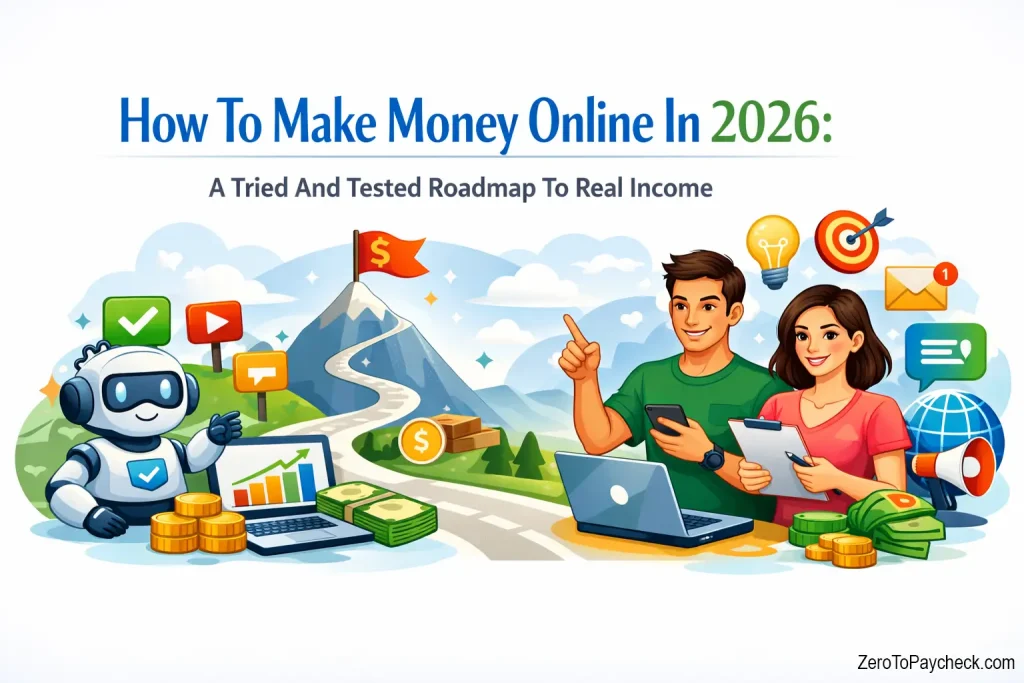
In this guide, I’m going to give you the honest version. The four proven paths that actually work, which one fits your situation, the tools you need, and a realistic 30-day plan to get started. No hype. No Lamborghinis. Just a clear roadmap.
Let’s establish some ground truth before we get into tactics.
The online economy is enormous and still growing. According to a 2024 report from McKinsey & Company, the global gig economy now encompasses over 435 million independent workers worldwide, and digital commerce continues to outpace traditional retail. A Pew Research Center survey found that 16% of Americans have already earned money through online platforms, and that number rises every year.
Remote work isn’t a pandemic fluke — it’s the new normal. Data from the Freelancers Union shows that freelancers contributed over $1.27 trillion to the U.S. economy in 2023 alone. The infrastructure for working and earning online has never been more developed, more accessible, or more legitimate.
| Quick Answer: Can you really make money online? Yes — but it requires real effort, a realistic timeframe, and the right strategy. Most people who fail do so because they either pick the wrong method for their situation or give up too soon. Treat it like starting a small business, because that’s exactly what it is. |
Who is this for? Honestly — anyone willing to trade effort for reward. If you have 5 to 10 hours a week to invest (consistently, not just when you feel like it), a genuine skill or the willingness to learn one, and the patience to play a long game, this is absolutely within reach.
Who is this NOT for? Anyone expecting a lottery ticket. If a “mentor” promises you a Lamborghini in 30 days, run. Fast. Backward. The red flags are real, and the predators in this space are many.
Here’s a framework I keep coming back to: there are basically two types of online income. Time-for-money, where you get paid for your hours (like freelancing), and scalable income, where you build something once and it generates revenue repeatedly (like a digital product or content channel). Neither is inherently better — it depends entirely on your situation.
Let’s break down the four main paths.
This is the fastest path to actual cash. If you have any marketable skill — writing, graphic design, video editing, social media management, coding, bookkeeping, customer service, translation — you can be earning within weeks.
Platforms like Upwork and Fiverr have made it easier than ever to connect with clients globally. And the demand is staggering. According to Upwork’s 2023 Skills Index, AI-related skills, copywriting, video production, and web development are among the most in-demand categories.
A friend of mine — a former teacher — started freelance writing on the side three years ago. She specialized in education content for EdTech companies. Within eight months, she’d replaced her teaching salary entirely. She now runs a small content agency. Her story isn’t unique. It is, however, the result of consistency, not luck.
| How to start freelancing in 3 steps: 1. Identify your strongest transferable skill (writing, design, admin, coding, etc.) 2. Create a profile on Upwork or Fiverr — use a real photo, write a clear bio, and add 2-3 work samples (even mock samples are fine to start) 3. Apply to 5 jobs per day for your first 30 days, and price competitively at first to build reviews |
Real expectations: You’ll likely earn little in the first month as you build reviews. By month 3, you can realistically hit $500 to $2,000 per month part-time. With consistency and specialization, $5,000+ per month is achievable within a year. Freelancers I’ve spoken with consistently report that the biggest challenge isn’t finding clients — it’s staying consistent when motivation dips.
This path covers anything from selling handmade jewelry on Etsy to running a dropshipping store to launching a print-on-demand brand. The common thread is that you’re moving physical (or physical-adjacent) products.
Here’s my contrarian take: dropshipping isn’t dead. But the lazy version is. A decade ago, you could spin up a generic Shopify store, throw some AliExpress products at Facebook ads, and make decent money. That era is over. What works now is brand-building — having a clear niche, a recognizable aesthetic, and a product that solves a real problem.
I’ll admit I was a huge skeptic about print-on-demand until I saw how a former colleague used it. She launched a line of motivational products targeting teachers, promoted it entirely on Pinterest and TikTok, and hit $3,000 in monthly revenue within six months. Her startup costs? Under $200. Printful handled all the printing and shipping. She just designed the products (using Canva, which is free) and ran the store through Shopify.
| E-Commerce starter checklist: • Pick a niche with passionate buyers (teachers, dog owners, runners, etc.) • Choose your model: print-on-demand (Printful + Shopify), dropshipping, or handmade (Etsy) • Set up your store — Shopify starts at $29/month; Etsy has zero upfront cost • Create 5–10 product listings with strong photos and keyword-rich descriptions • Set up a PayPal or Stripe account to receive payments |
This is where the concept of “passive income” lives — and where it’s most often misunderstood.
Digital products include e-books, online courses, templates, spreadsheets, Notion dashboards, Lightroom presets, and membership communities. The idea is compelling: create once, sell forever. But here’s what surprised me the first time I launched a digital product: the upfront work is immense. Writing a quality e-book, recording a polished course, building a sales funnel — this isn’t passive. It’s more accurately described as “delayed-gratification income.” You put in massive effort upfront, and the payoff comes later, repeatedly.
Pat Flynn, who built the blog Smart Passive Income into a multi-million dollar brand, has been honest about this for years: passive income is the result of massive active work first. Don’t let anyone tell you otherwise.
That said, the upside is real. A well-positioned course on Teachable or Gumroad can earn while you sleep — once you’ve built an audience to sell to. That’s the catch. You need distribution. Which leads us to path four.
| Digital product launch steps: 1. Identify a specific problem you can solve (not “marketing” — more like “Instagram captions for real estate agents”) 2. Validate the idea: do people pay for this? Search Etsy, Gumroad, or Udemy for similar products 3. Create your product using Canva (for visual products), Notion, or a screen recorder for courses 4. Host on Gumroad (free to start) or Teachable, and connect your Stripe account 5. Promote to your existing network first — your first 10 customers should come from people you know |
This is the long game. The marathon. And it’s the one most people either underestimate or overestimate simultaneously.
Content creation means building an audience through a blog, YouTube channel, podcast, newsletter, or social media presence — and then monetizing that audience through ads (Google AdSense, YouTube monetization), affiliate commissions, or sponsored content. Affiliate marketing means you recommend products and earn a commission when someone buys through your link. Amazon Associates is the most well-known program; ShareASale and Commission Junction offer thousands more.
Everyone says you need a million followers to make money online. That’s not just wrong — it’s dangerous advice. A reader named Sarah recently emailed me: “But isn’t the market just completely saturated? How does anyone break through?” Here’s what I told her: scale doesn’t matter as much as specificity. I know a guy who built a newsletter about recreational pickleball strategy. He has 4,200 subscribers. He makes $2,800 per month through affiliate links to gear and a $9/month premium tier. He’s not MrBeast. He’ll never be. And he doesn’t need to be. Find a specific audience with a specific need, and serve them better than anyone else.
The math on 1,000 true fans works like this: if 1,000 people love what you make enough to spend $100 per year on your products or recommendations, that’s $100,000 annually. You don’t need to go viral. You need to be genuinely useful to a smaller group.
| Content creation fast-start checklist: • Pick ONE platform: YouTube for video, a blog for writing, or a newsletter (try ConvertKit’s free tier) • Choose a niche you actually know something about — expertise always outperforms enthusiasm alone • Commit to publishing once per week for 6 months before judging results • Sign up for Amazon Associates and 1–2 niche affiliate programs relevant to your content • Enable Google AdSense on your blog or apply for YouTube monetization (1,000 subscribers / 4,000 watch hours required) |
| Method | Speed to Income | Income Ceiling | Effort Level |
| Freelancing | Fast (weeks) | Medium–High | High (ongoing) |
| E-Commerce | Medium (months) | High | High upfront |
| Digital Products | Slow (6–12 mo) | Very High | High upfront, low later |
| Content / Affiliate | Slow (12–24 mo) | Very High | Consistent, long-term |
Bottom line: if you need money soon, start with freelancing. If you’re playing the long game and have the patience, build toward digital products or content. Many successful online earners do both — they freelance for cash flow while building an asset on the side.
You don’t need to spend a fortune. Here’s the honest toolkit — what’s actually worth paying for and what you can start with for free.
In my experience, if I were starting over with $100, I’d spend it on a domain name ($12), one month of Shopify or a basic hosting plan ($29), and keep the rest for paid ads testing. Everything else can be free at the start.
Analysis paralysis will kill your chances faster than any market saturation. Here’s a concrete plan. Follow it in order.
Read through all four paths above. Which one genuinely excites you? Which feels most connected to a skill you have or could build quickly? Write your answer down. Then commit. You are not allowed to switch paths for the next 90 days.
Action beats perfection. Every time.
Month 2 and beyond: focus on what worked in month one. Double it. The people who succeed don’t find a magic strategy — they find a working strategy and repeat it relentlessly.
You start freelancing, then read about dropshipping, then pivot to affiliate marketing, then buy a course on crypto. Six months later, you’ve made $0 and burned yourself out. The solution is almost aggressively boring: pick one thing, and stick with it for at least 90 days before evaluating.
This is epidemic in the freelance world. New freelancers price by what they think clients will accept rather than the value they deliver. A blog post that generates $10,000 in traffic for a company is worth far more than $50. Research market rates on Glassdoor and Upwork before setting your prices. And raise them every 6 months as your skills grow.
Look, I know it’s boring. But this one can genuinely hurt you. Any self-employment income over $400 in the U.S. is taxable. Set aside 25–30% of everything you earn for taxes. Pay estimated quarterly taxes (due in April, June, September, and January). Eventually, consider forming an LLC for liability protection — it’s simpler than it sounds and costs around $50–$150 depending on your state.
We covered this above, but it bears repeating. Passive income is real. But it’s the output of sustained active work. Expect to invest 6 to 18 months of real effort before your income streams feel truly autonomous.
This might be the most common and most tragic mistake. Most people quit at the exact point where persistence would have paid off. I’ve seen it dozens of times. Adopt this mindset: commit to 100 days of consistent action before making any judgment about whether something is working. One hundred days. Write it somewhere you can see it.
| A word on hustle culture: while consistency matters, grinding yourself into exhaustion doesn’t. The most sustainable online businesses I’ve seen are built by people who treated their side income like a slow cooker — steady, low heat, over time — not a pressure cooker. Burnout is a real threat in this space, and it’s rarely discussed. Set boundaries. Work sustainably. This is a marathon. |
Here’s the honest timeline. No asterisks, no “results may vary” disclaimers buried at the bottom. These are based on real patterns from people I’ve personally known or spoken with.
| Timeline | Realistic Range | What’s Happening |
| Month 1–3 | $0 – $500 | Learning, setting up, landing first client or sale |
| Month 6–12 | $1,000 – $3,000/mo | Systems in place, repeat clients or growing audience |
| Year 2+ | $5,000 – $15,000+/mo | Scaled operations, passive income streams active |
Factors that accelerate results: having a highly marketable skill, working in a high-demand niche, investing in a small amount of paid advertising, and — most importantly — consistency. Factors that slow results: switching methods, inconsistent effort, pricing too low, and not building an email list from day one.
Disclaimer: These ranges are typical but not guaranteed. Individual results depend heavily on niche, skill level, effort, and market conditions. Online income is real and attainable, but there is no guaranteed outcome in any business.
Not at all. Freelancing requires zero upfront investment beyond your time. Content creation can start free. Digital products can be created and hosted on Gumroad at no cost. E-commerce has the highest barrier, but you can start an Etsy shop for $0.20 per listing. Start with what you have.
Honestly? No. The internet is enormous, and most niches still have room for one more person who’s genuinely better or more specific than what’s already out there. The “saturated” markets are the generic ones — “fitness tips” or “make money online” as a broad topic. But “strength training for women over 50” or “tax tips for Etsy sellers”? Still wide open. Specificity is the antidote to saturation.
Three rules: First, never pay for information you can find free on YouTube or Google. Second, be deeply skeptical of anyone whose primary credential is their lifestyle (the car, the house, the vacation). Third, look for teachers whose business model is the thing they’re teaching — not teaching people to teach others the same thing. Legitimate educators show their actual business results, not just their course launch results.
Start with freelancing in a service that requires less specialized knowledge: virtual assistant work, social media scheduling, data entry, or basic customer service. These have low skill floors and genuine demand. As you earn your first dollars, invest that money into learning a higher-value skill. This is how most successful online earners got their start — not with a grand plan, but with a humble first step.
Yes. Many people have. But plan for at least 12 to 24 months of part-time effort before attempting to make the leap. Build your online income to at least 75–80% of your current salary before quitting, and have 3–6 months of expenses saved as a buffer. Jumping too early is one of the biggest mistakes people make — the financial pressure kills creativity and patience.
Once you’ve chosen your path, these guides will help you go further faster:
Let me bring this back to where we started: that Sunday evening feeling. The dread. The math that doesn’t add up. The quiet wish for something different.
Here’s the truth I’ve arrived at after 20 years of watching people build businesses online and off: the methods work. The four paths I’ve outlined — freelancing, e-commerce, digital products, content creation — have produced real income for real, ordinary people. Not just lucky people, not just “entrepreneurial” types. Teachers. Nurses. Accountants. Stay-at-home parents. People with 10 hours a week and a clear goal.
What separates the people who make it from the ones who don’t isn’t talent. It’s not connections. It isn’t even the right method. It’s the decision to start, and then the discipline to keep going past the point where most people quit.
So here’s my ask: don’t close this tab and let it join the graveyard of good intentions. Right now — not tonight, not this weekend — right now, pick one of the four paths. Spend 30 minutes setting up one account. Upwork, Fiverr, Etsy, Gumroad, or a free ConvertKit account. That’s it. That’s the start.
The Sunday night dread doesn’t have to be permanent. But it also won’t change on its own. One decision. One account. Thirty minutes. Go.
Disclaimer: This article is for informational purposes only. Income figures mentioned reflect realistic possibilities based on industry data and real-world examples, but are not guarantees. Individual results will vary based on effort, skill, niche selection, and market conditions. Always consult a qualified tax professional or financial advisor regarding your specific situation.