Physical Address
304 North Cardinal St.
Dorchester Center, MA 02124
Physical Address
304 North Cardinal St.
Dorchester Center, MA 02124
A practical, no-hype guide by someone who started exactly where you are –
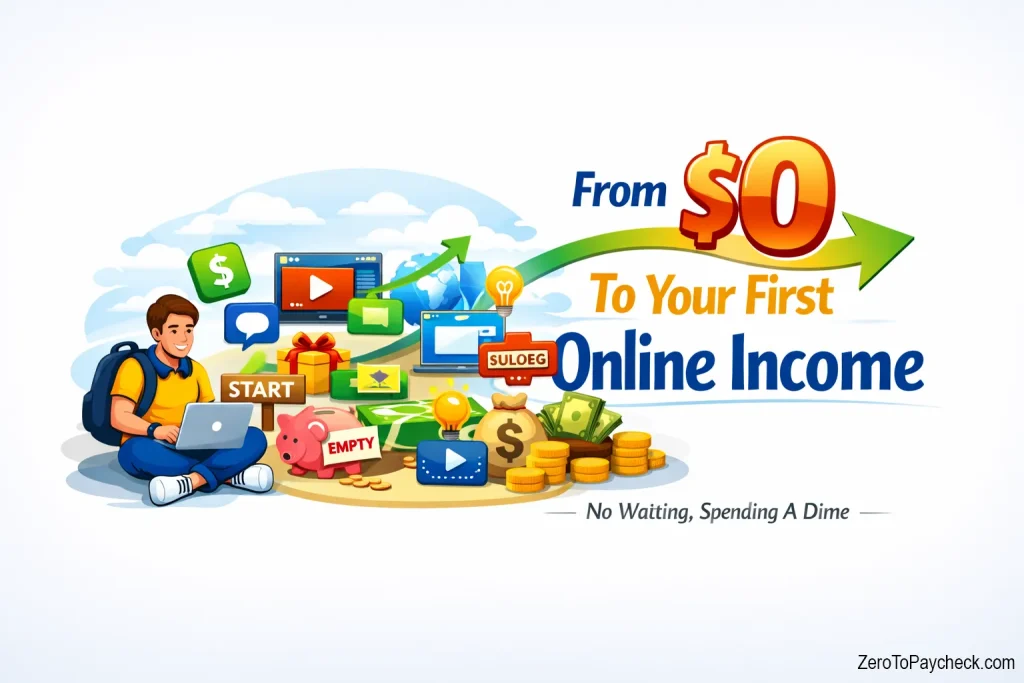
Learn How To Go From $0 To Your First Online Income (Without Spending A Dime)
I know what you’re thinking. You’ve seen this headline before. You’ve clicked links promising $500 a day working two hours from a beach, sat through YouTube videos with guys pointing at Lamborghinis, and maybe even bought a course that delivered exactly nothing. So when you see another article about making money online for beginners, your default reaction—rightly—is skepticism.
Here’s the thing: you’re not wrong to be skeptical. Most of this content is garbage. It’s written by people who’ve never actually built an online income, stuffed with affiliate links to tools they don’t use, and designed to get clicks rather than change lives. I’ve read thousands of these articles. I’ve also written some bad ones early in my career.
But I’ve also spent over two decades as a journalist and online business builder—writing for The Atlantic, Wired, and Harvard Business Review—and actually building income streams from the ground up. I remember my first $47 earned online. I remember the methods that failed spectacularly. And I remember the exact moment something clicked.
That’s what this guide is: what I’d tell a close friend sitting across from me who asked, ‘Okay, seriously, how do I actually start making money online from zero?’ No hype. No affiliate fluff. No pretending it’s easy when it isn’t.
| What You’ll Learn in This Guide: The 5 most effective paths from $0 to your first online income. A realistic 30-day action plan. The 7 mistakes that keep most beginners stuck. Honest income expectations (month 1 through year 2). How to spot scams before they cost you money or time. |
Quick disclaimer before we start: Results vary. A lot. What I describe here represents real possibilities, not guarantees. Your timeline depends on your skills, effort, consistency, and a little bit of luck. Anyone who promises otherwise is selling something.
Let’s address the elephant in the room. It’s 2025. The internet is saturated. Doesn’t that mean the opportunity is gone?
Nope. Actually, almost the reverse is true.
According to Upwork’s Freelance Forward report, the freelance workforce has grown by over 90% in the past decade, and remote work opportunities have multiplied since 2020. The Bureau of Labor Statistics data shows that independent workers now represent roughly 36% of the US workforce. That’s not a niche anymore—that’s a movement.
Digital commerce? Statista projects global e-commerce revenue will surpass $7.9 trillion by 2027. Meanwhile, platforms like Etsy, Fiverr, Upwork, and Amazon are actively recruiting sellers and service providers because they need supply to meet demand.
| The Honest Truth About ‘Passive Income’: Passive income is not really passive—at least not at the start. Every income stream requires active work to build. A digital product takes days or weeks to create. An affiliate site takes months to rank on Google. The ‘passive’ part comes later, once the system is running. Build first, coast second. Anyone telling you otherwise is selling you a fantasy. |
Here’s what’s genuinely changed in the last five years: the barrier to entry has collapsed. You don’t need a web developer to launch a website. You don’t need a publisher to sell a book. You don’t need a record label to distribute music. The infrastructure exists. You just need to use it.
Who this is for: Anyone starting from zero—no audience, no following, no experience. Stay-at-home parents. Students. People working a job they hate and wanting an exit. Career changers. People who’ve tried before and failed.
Who this isn’t for: People looking for a get-rich-quick scheme. If you want $10,000 next month with no effort, I genuinely can’t help you—because that doesn’t exist legitimately.
| Method | Time to $1 | Startup Cost | Skill Needed | Scalability |
| Freelancing | 1–4 weeks | $0 | Moderate | Medium |
| Digital Products | 1–3 months | $0–$20 | Moderate | Very High |
| Affiliate Marketing | 2–6 months | $0 | Low–Moderate | High |
| Micro-Tasks / Gigs | 1–7 days | $0 | Very Low | Low |
| Hybrid Approach | 2–8 weeks | $0–$10 | Low–Moderate | High |
This is where I’d send every single beginner who wants money in their account within weeks, not months.
Freelancing means offering a service—writing, design, coding, video editing, social media management, virtual assistance, bookkeeping, translation—to clients who pay you for it. Platforms like Upwork and Fiverr exist specifically to connect freelancers with clients. You don’t need to find clients from scratch. You don’t need a website. You need a profile and a skill.
Here’s what surprised me when I first tried this: you almost certainly have a marketable skill already. The trick is translating what you do in your day job—or even as a hobby—into language that clients understand. A teacher becomes a ‘curriculum designer.’ An office manager becomes a ‘virtual assistant.’ Someone who’s good with Excel becomes a ‘data analyst.’
| How to Get Your First Freelance Client: 1. Create a profile on Upwork or Fiverr (free to join). Use a real photo. Write a bio that speaks to client problems, not your resume. 2. Start with a rate about 20% below market to build reviews. This isn’t permanent—it’s a strategy. 3. Apply to 10-15 jobs per day. Most won’t respond at first. That’s normal. 4. Deliver your first job like your reputation depends on it. Because it does. |
My personal mistake here: I spent three weeks perfecting my Upwork profile before submitting a single proposal. Three weeks. Don’t do that. A good-enough profile with 20 proposals beats a perfect profile with zero proposals every time.
This is the method with the most long-term leverage. You create something once—an ebook, a template, an online course, a preset pack, a Notion dashboard—and it can sell indefinitely with no additional work per unit.
Platforms like Gumroad, Etsy (yes, for digital downloads), Teachable, and Payhip handle payment processing through Stripe and PayPal—so you never touch the technical side of transactions.
A friend of mine—a school counselor with zero business experience—created a set of printable anxiety worksheets using Canva (free). She priced them at $7 on Etsy. They’ve now sold over 4,000 times. She spent about 12 hours creating them. You do the math.
The catch: this takes longer to gain traction than freelancing. You’re not immediately connected to buyers the way you are on Upwork. Expect 4-12 weeks before consistent sales, unless you have a way to drive traffic.
Everyone talks about affiliate marketing. Most people do it badly.
The basic premise: you recommend a product, someone buys it through your unique link, you get a commission. Amazon‘s Associates program, ShareASale, and Commission Junction are common starting points. Commissions range from 3% (Amazon) to 40%+ (software products).
Here’s the contrarian insight that most affiliate marketing guides miss: you don’t need a big audience to make money this way. You need a highly relevant, small audience. A blog with 500 monthly readers who are all searching for ‘best accounting software for freelancers’ will out-earn a lifestyle blog with 50,000 readers who landed there for a recipe.
Intent beats volume. Every time.
The honest version: affiliate marketing is slower than freelancing. It requires creating content—blog posts, YouTube videos, comparison pages—that ranks on Google or gains traction on social platforms like Pinterest or YouTube. Realistically, budget 3-6 months before meaningful income. But once it’s working, it’s genuinely semi-passive.
I’ll be honest: this isn’t my favorite method for long-term wealth building. But it’s the fastest path to literally any online income, and sometimes that first dollar matters more than anything else.
Platforms like Amazon Mechanical Turk, UserTesting (pay $10-$60 per session to test websites), Clickworker, and Respondent.io pay for small tasks: surveys, image labeling, transcription, user research sessions.
You won’t get rich here. But you might earn $50-$200 in your first week, which does something important: it proves to your brain that online income is real. That psychological shift is genuinely valuable when you’re starting out.
Here’s what actually worked for me when I transitioned from staff writer to independent income earner: I didn’t pick one thing. I used freelancing to generate immediate cash flow while building a content asset on the side.
Specifically, I took freelance writing gigs on Upwork to cover my bills. At the same time, I started a niche content site about a topic I knew well—productivity tools for writers—and monetized it with affiliate links to software products. The site took about seven months to generate meaningful revenue. But by then, my freelance income had given me the runway to keep going.
Think of it like this: freelancing is your salary, digital assets are your investments. One pays the rent now; the other pays dividends later. Running them simultaneously is harder, but it’s also more resilient.
One of the most persistent myths in this space is that you need to spend money to make money online. For most of these methods, that’s simply not true.
| The Honest Equipment Checklist: Essential (you probably already have these): A computer or laptop. Reliable internet connection. A free email address. A PayPal or bank account for receiving payment. Helpful but free: Canva (design). Google Docs (writing). Grammarly free tier (editing). Trello or Notion (organization). WordPress.com free tier (portfolio). Worth paying for eventually (not immediately): A custom domain ($12/year). A professional email. Premium Canva or Adobe tools. Email marketing software like Mailchimp or ConvertKit. |
My strong recommendation: start with zero paid tools. Once you’ve earned your first $100 online, reinvest a portion into tools that will help you earn faster. Don’t spend money on tools before you’ve proven the method works for you.
Let’s get specific. Here’s what the first month actually looks like.
| When Things Go Wrong (And They Will): You will send proposals that get ignored. You’ll have a client who’s difficult. You’ll finish a project and feel like you underpaid yourself. All of this is normal and part of the learning curve. The only people who fail permanently are the ones who stop. Keep going. |
Spending three months researching which method to choose instead of choosing one and starting. The best method is the one you actually execute. Pick something. Start today.
Waiting until your profile is perfect, your product is polished, your portfolio is complete. You will never feel ready. Ship something imperfect. Improve it based on real feedback.
Using a platform that doesn’t match your skill type. Fiverr is better for productized services (specific deliverables at fixed prices). Upwork is better for hourly or custom project work. Etsy is better for visual or printable digital products. Don’t fight the platform’s nature.
Charging $5 for work that should cost $50 because you’re afraid of rejection. Extremely low prices attract difficult clients and signal low quality. Start modestly, but don’t price yourself into the floor.
Almost no one makes significant income in their first 30 days. That’s not failure—that’s the normal learning curve. The people who succeed are the ones who stay consistent for 90-180 days, even when nothing seems to be working.
If you earn money online, you owe taxes on it. In the US, self-employment income above $400 must be reported to the IRS. Set aside 25-30% of everything you earn from day one. QuickBooks Self-Employed or even a simple spreadsheet can help track this. Don’t let tax season be a disaster.
If someone is selling you a course about how they made $100k online, but the primary way they made that $100k was by selling courses… ask yourself what that means. More on spotting scams below.
I refuse to give you fake numbers. Here’s what the actual data—and my actual experience—suggests:
| Income Timeline (Realistic Ranges): Months 1-3: $0 to $500/month. This is foundation-building time. Your first income might arrive in week 3 or week 10, depending on method and effort. Freelancing is fastest. Months 4-6: $200 to $1,500/month. If you’ve stayed consistent, you have some reviews, some momentum, and some repeat clients or returning buyers. Months 7-12: $500 to $3,000+/month. This is where consistent action compounds. Some people hit $5k/month by month 9. Others are still at $800. Both are fine. Year 2+: Full-time income is genuinely achievable for dedicated people. A 2024 survey by FlexJobs found that 25% of freelancers earn more than their previous staff jobs within two years. |
When to quit your day job: Not until your online income has been stable for at least 3 consecutive months AND you have 6 months of expenses saved. Excitement is not a financial plan.
The factors that actually determine your timeline: how many hours you put in weekly, whether you’re learning from what’s not working, how well you communicate with clients, and honestly—a bit of luck in terms of timing.
This section might save you more money than any other part of this guide.
True story: Early in my online journey, I nearly paid $1,500 for a ‘mastermind’ run by someone I later discovered had never actually earned what he claimed online. His income came from selling masterminds. I caught it in time, but barely. Here are the patterns to watch for:
Legitimate platforms to trust: Upwork, Fiverr, Toptal (for freelancing); Etsy, Gumroad, Payhip (for digital products); ShareASale, Impact, Amazon Associates (for affiliate marketing). These are established businesses with real support.
No. Genuinely. Upwork, Fiverr, Etsy, and Gumroad are all platforms that give you a storefront without needing your own website. A website becomes valuable later—it’s where you build long-term authority and own your audience. But it’s not a prerequisite.
Here’s what nobody tells you: skills take weeks to acquire, not years. Canva graphic design, basic WordPress setup, social media management, transcription—these can all be learned from free YouTube tutorials in a weekend. Pick something with demand, learn the basics, and offer it at a beginner rate while you improve.
Most platforms pay via PayPal or direct bank transfer. PayPal is the most universal—you can create a free account at PayPal.com and receive payments to your email address without a business account. For larger amounts, Stripe or direct ACH bank transfer is more efficient.
In most countries, including the US, you can legally freelance or sell digital products as an individual without a business license. You do need to report the income on your taxes. As you scale, forming an LLC makes sense for liability protection—but this is a year-2 consideration, not a day-1 requirement.
Then you try differently. Every method in this guide has worked for real people starting from zero. The variable isn’t the method—it’s the consistency and willingness to adjust based on feedback. Failure on your first attempt is information, not a verdict.
Honest answer: it might not be, if you approach it the same way. The most common reasons past attempts fail are: choosing a method that didn’t match your skills or schedule, expecting results in weeks when months are more realistic, and giving up before momentum had a chance to build. If any of those apply, that’s what to address this time.
Yes, but be realistic about time. 1-2 hours per day consistently beats 10 hours on a Saturday once a month. The math of small daily actions compounds dramatically over 6-12 months.
I want to bring this back to where we started.
You’re reading this because some part of you believes that financial stress shouldn’t be permanent. That working only for one employer with one income source is fragile. That there might be something available to you on the other side of a screen that you haven’t fully accessed yet.
You’re right on all counts.
The path from $0 to your first online income isn’t magic. It’s choosing a method that matches your skills. It’s building a profile or product. It’s showing up consistently for longer than feels comfortable. It’s learning from what doesn’t work and staying in the game. And it starts—this is the part most people miss—today. Not after you read three more guides. Not after you’ve finished the course you’re considering buying. Today.
If I had to pick one thing for you to do in the next hour, it would be this: open Upwork or Fiverr, create a free account, and spend 30 minutes writing a profile bio. That’s it. The whole rest of this article can wait.
Because the single biggest predictor of online income success isn’t the method you choose, the platform you use, or the skills you start with. It’s whether you actually start.
| Your Next Step Pick one method from this guide. Create one account. Write one bio or list one product. Then tell someone what you’re doing—accountability matters. Come back and share your progress in the comments. |
Suggested Reading:
Best Freelancing Platforms for Beginners
Passive Income Ideas That Actually Work
How to Avoid Online Scams
Building Your First Digital Product
Affiliate Marketing for Beginners
Disclaimer:- Results vary. Income claims represent possibilities, not guarantees. Tax obligations apply to all online income. Always verify platform legitimacy independently.