Physical Address
304 North Cardinal St.
Dorchester Center, MA 02124
Physical Address
304 North Cardinal St.
Dorchester Center, MA 02124
Let me be honest with you for a second.
When I first started looking for ways to make money online, I had $43 in my checking account and a laptop with a cracked screen. I remember reading articles like “10 ways to make $10,000 a month from home” and feeling two things simultaneously: desperate hope and deep skepticism. Because here’s what those articles never said — they were written for people who already had something. A skill. An audience. A product. Capital.
You, right now, might have none of those things. And that’s exactly who this guide is for.
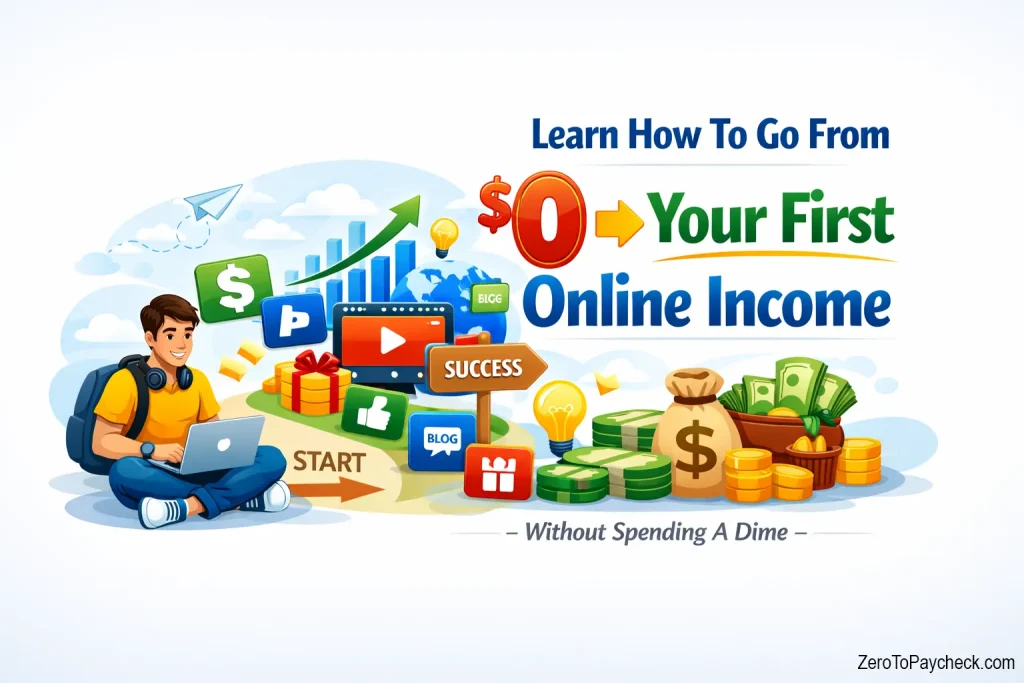
We’re not going to talk about becoming a millionaire. We’re going to talk about something more powerful: making your first dollar online. Then your first $100. Then, if you stay consistent, your first $1,000. Because I’ve watched that progression happen — in my own life and in the lives of people I’ve coached — and it almost always starts the same way: with someone who had nothing but time and the willingness to start ugly.
Here’s what you’ll actually learn in this guide:
A word of warning before we dive in: this isn’t a get-rich-quick scheme. There are plenty of those on the internet, and none of them work. What this is, instead, is a practical, step-by-step blueprint for turning your most abundant resource — time — into actual money. Sound good? Let’s get into it.
I know that sounds like motivational poster nonsense. Stick with me.
When I started out, I spent 40 hours building a website for a virtual assistant service that nobody wanted. I designed a logo, wrote out pricing packages, recorded a demo video. The whole thing. It was beautiful, honestly. And it was a complete waste of time, because I’d built the thing before I knew if anyone would pay for it.
That failure taught me the most important lesson in this business: people with resources optimize. People without resources improvise. And in the early stages of building online income, improvisation beats optimization every single time.
When you have no money, you can’t buy ads, so you learn organic marketing. You can’t hire a developer, so you learn to build simple things yourself. You can’t invest in inventory, so you offer services. Every constraint forces creativity. And creativity, in the online economy, is the actual product.
Here’s the data to back that up: According to the 2023 Freelance Forward survey by Upwork, over 64 million Americans freelanced in the past year — and the majority started with nothing more than a skill and a free account on a platform. The “skills economy” is now valued at over $1.5 trillion globally, and it rewards people who can do things, not just people who have things.
Who is this approach for? Honestly, it’s for the hustler. The person who will stay up an extra hour, who will send one more pitch, who will learn one more thing. It is not — and I’ll be straight with you — for the passive dreamer who thinks there’s a magic button that generates income while they sleep. That button doesn’t exist. At least not on day one.
Quick Answer: Why starting with $0 works — The online economy rewards skills and time over capital. Platforms like Upwork, Fiverr, Gumroad, and Etsy are free to join and give anyone with internet access a global marketplace. Your first asset isn’t money — it’s hours.
This is the fastest path. Period.
Freelancing is exactly what it sounds like: you offer a service, someone pays you for it, you deliver it, you get paid. No inventory. No upfront cost. No elaborate setup. Just a skill, a profile, and a willingness to show up.
“But I don’t have any skills.” Hang on — we’ll get to that. For now, let’s talk about how this actually works.
Platforms like Upwork and Fiverr let you create a free profile and start offering services to millions of potential clients around the world. According to Upwork’s internal data, new freelancers land their first project within an average of 3 weeks of actively applying. Three weeks. That’s not a lot of runway.
Here’s my contrarian take, and I really mean this: don’t niche down yet. Every “how to freelance” article will tell you to pick a niche — “be a copywriter for SaaS companies” or “be a social media manager for restaurants.” That advice is great… once you have experience. When you have zero experience and zero reviews, you need to be a generalist who takes anything legal that someone will pay you for. Write product descriptions. Transcribe audio. Do data entry. Format spreadsheets. Edit photos. The goal of your first 30 days is not to find your niche — it’s to find your first paycheck.
Here’s a step-by-step to get your Upwork or Fiverr profile live today:
While we’re on the subject of Fiverr, let me rant for a second about profile pictures. I’ve seen countless beginners use blurry selfies, cartoon avatars, or — worst of all — no photo at all. Your profile picture is doing more work than you realize. It’s the first thing a potential client sees. Use a clear, well-lit, front-facing photo where you’re smiling. That’s it. That’s the entire secret. Clients are humans too. They want to hire a person, not a logo.
Upwork vs. Fiverr for Beginners — Here’s a quick comparison:
| Feature | Upwork | Fiverr | Best For |
| Setup Time | 30 min | 15 min | Fiverr wins |
| Fee | 20% sliding | 20% flat | Tie |
| Getting Work | You bid | Clients find you | Upwork (more control) |
| Min. Payout | $1 | $20 | Upwork wins |
| Best Niche | Complex projects | Quick gigs | Depends |
| Beginner Edge | Connects system | Easy setup | Both — try both |
Bottom line: Sign up for both. They’re free. Test which one gets traction for you in the first two weeks.
I’ll be honest: I was skeptical of digital products for a long time. They seemed like the domain of influencers and “gurus” — people with big audiences who could sell an e-book to their followers. Not for a nobody starting from zero.
Then a friend of mine — a stay-at-home mom with no social media following and a basic Canva account — made $340 in her first month selling resume templates on Etsy. I dug in. Here’s what actually works.
A digital product is any file someone pays to download: a template, a checklist, a guide, a spreadsheet, a set of icons. That’s it. And what surprised me when I first tried this wasn’t the technical side — it was how simple the products could be. A one-page cleaning schedule template. A “questions to ask at a job interview” PDF. A social media caption pack.
The platforms with zero listing costs:
Use Canva (free) to design your product. For templates specifically, a single well-designed file can earn passive income for months after you create it. That’s the semi-passive income model — active work upfront, passive returns later.
Realistic expectation: Your first digital product might earn $0 in month one. That’s normal. This method takes longer than freelancing. But it has a ceiling that freelancing doesn’t.
This is the starter engine — not a long-term strategy, but a fast way to get your first dollar while you’re building the other methods.
Selling what you already own: Facebook Marketplace, eBay, and Craigslist are full of people making real money flipping items they own or find for free (think: library book sales, curb finds, garage sales). Zero investment required if you’re selling things you already have.
Micro-tasks: Platforms like UserTesting.com pay $10 for 20-minute website tests. Scribie pays for audio transcription (around $0.10/minute). Amazon Mechanical Turk offers small tasks for small pay — not glamorous, but real money while you’re building bigger income streams.
One of the biggest lies in the “make money online” world is that you need to invest in tools and software to get started. You don’t. Here’s everything you actually need:
That’s it. Truly. You do not need a website, a Shopify store, an email marketing tool, or a paid course. Not yet. What I’ve personally found is that beginners who invest money before earning money almost always lose money. Don’t pay for anything until you’ve earned your first $500. By then, you’ll know exactly what’s worth paying for.
This is the section you should screenshot, bookmark, and come back to daily. It’s a practical, day-by-day action plan. If you follow it, you will significantly increase your chances of earning your first dollar within a week. No guarantees — effort and luck both play a role — but this is exactly the sequence I’d recommend to a close friend starting from zero.
Sit down with a pen and paper (yes, physical paper — it forces different thinking) and answer these three questions:
Your “offer” doesn’t have to be fancy. It can literally be: “I will write five product descriptions for your Etsy shop for $15.” That’s an offer. Write it down. Make it specific.
A reader named Dave once emailed me asking: “But what if I have no work samples? Nobody will hire me without samples, and I can’t get samples without being hired first.” Great question, Dave. It’s a real chicken-and-egg problem. Here’s the solution: make samples.
If you want to write product descriptions, go to a random Etsy store, pick three products, and rewrite their descriptions better than they currently are. That’s your portfolio. If you want to do graphic design, redesign a local restaurant’s menu using Canva and include it as a spec project. Nobody needs to know you weren’t hired. You’re proving you can do the work.
Host your portfolio on a free Google Sites page or simply share a Google Drive folder. You do not need a website.
Here are specific places to find your first client, ranked by ease of access for a complete beginner:
Copy this pitch template and customize it for each application:
Hi [Name], I noticed you’re looking for [service]. I specialize in exactly this — [one sentence about your relevant skill/experience, even if it’s personal]. I can deliver [specific deliverable] within [timeframe]. To give you a sense of my work, here’s a sample: [link to Google Drive portfolio]. I’d love to do a small test project at a reduced rate so you can see the quality firsthand. Does that work for you? — [Your Name]
Notice what that pitch does: it’s specific, it offers proof, and it lowers the risk for the client by offering a test project. Getting your first online client is like asking someone on a date — terrifying until they say yes. The key is lowering the psychological barrier for them to say yes.
When someone responds, they’ll often ask for a lower price, a longer timeline, or more samples. Here’s how to handle the most common objections:
Once you have a client, deliver over-promise. Turn in work early. Add a small bonus (an extra description, a cleaner format). Then invoice immediately.
To send a PayPal invoice: Log into PayPal → Click “Send & Request” → “Request Money” → enter your client’s email → enter the amount → add a note describing the work → send. They’ll receive an email with a payment link. Done. Your bank account (or PayPal balance) will be updated the moment they pay.
For larger clients or ongoing work, Stripe is more professional. But PayPal is fine to start.
You made money on the internet. Let that sink in. Now: ask your client for a review (on Upwork/Fiverr, reviews are everything). Ask if they have any recurring needs. Ask if they know anyone else who might need your service.
That last question — “do you know anyone?” — is the most underused growth hack in freelancing. One referral compounds everything.
Pitfall 1: Perfectionism
Waiting until your profile looks perfect, your portfolio is polished, your website is live. Perfectionism is procrastination wearing a productivity costume. Launch ugly. The market will tell you what to fix.
Pitfall 2: Shiny Object Syndrome
Week 1: “I’ll try dropshipping.” Week 2: “Actually, affiliate marketing sounds easier.” Week 3: “Wait, have you heard about print-on-demand?” Sound familiar? Pick one method from this guide and commit to it for 30 days. Thirty days. That’s all. You cannot build momentum by constantly switching tracks.
Pitfall 3: Pricing Yourself Into Invisibility
Two ways beginners get this wrong: pricing too high (nobody hires them) or pricing so low that clients assume they’re incompetent. Starting at $10–$15/hour is reasonable for a new freelancer. Never go below $5/hour — it signals desperation and often attracts the worst clients.
Pitfall 4: Not Asking for the Sale
You wrote the pitch. You had the conversation. The client seemed interested. Then… nothing. You waited. They forgot. Follow up. Twice. Politely. “Hi [Name], just checking in on my proposal from Tuesday. Happy to answer any questions or adjust the scope.” So many sales are lost simply because someone didn’t follow up once.
Pitfall 5: Ignoring Taxes from Day One
Unglamorous but important. In most countries (including the US), freelance income is taxable — and no employer withholds it for you. As a general rule: set aside 25–30% of every payment you receive for taxes. Keep records of every transaction. Consider using free tools like Wave (free accounting software) from day one. This avoids a very unpleasant surprise come tax season. I’m not a tax advisor — please consult one for your specific situation — but starting with good habits costs nothing.
SCAM ALERT — Red flags to watch for:
Disclaimer: The following income ranges are illustrative based on observed patterns. Individual results vary significantly based on time invested, skills, market demand, and consistency. Nothing here constitutes financial advice.
Week 1: $5 – $100
The goal here isn’t money. It’s proof of concept. Earning even $5 online changes something in your brain — it makes the whole thing real. Focus on landing one paying project, even a small one.
Month 1–3: $100 – $1,000/month
This is the building phase. You’re getting reviews, refining your offer, finding which types of clients you work well with. According to Upwork’s data, freelancers who consistently apply to jobs for 60+ days average $1,400/month by month three. Consistency compounds.
Month 6–12: $1,000 – $3,000+/month
This is where niching down starts to make sense. You’ve tried different types of work, you know what you enjoy and what clients want to pay for. Now you specialize, raise your rates, build retainer relationships, and start diversifying with digital products on the side.
Factors that influence how fast you get there: hours invested per week, how quickly you learn from rejection, your ability to communicate professionally, and honestly — a little luck in landing your first anchor client.
I recently spoke with a single mom — let’s call her Maria — who used the freelancing method above to replace her part-time retail income in three months. She started by offering customer service scripts and email responses on Upwork for $12/hour. By month two, she had three repeat clients and raised her rate to $18. By month four, she had quit the retail job. She told me the hardest part wasn’t the work — it was believing she was allowed to charge for it.
Another person, a college student in the Philippines, started selling Canva resume templates on Etsy with zero social media presence. His first sale came three weeks after listing. Within six months, he had 47 sales and a 4.9 rating, earning $340/month with zero ongoing effort beyond the initial creation.
These aren’t outliers. They’re what happens when ordinary people apply consistent effort to legitimate methods.
Everybody has skills — they’re just not always obvious. Here are five things most people can do that someone will pay for: (1) data entry and spreadsheet organization, (2) customer service emails and chat responses, (3) basic research and summarization, (4) proofreading and light copyediting, (5) social media scheduling and posting. If you can use a computer, you can do at least one of these things. Start there.
PayPal works without a traditional bank account — you can hold a balance and spend it via the PayPal prepaid Mastercard. Payoneer is another excellent option, particularly for international users. Wise (formerly TransferWise) is great for cross-border payments with low fees. You have options.
The internet doesn’t care where you live. Upwork and Fiverr both operate globally — clients from the US, Europe, and Australia actively seek freelancers in lower cost-of-living countries because the currency difference often works in everyone’s favor. The biggest global opportunity right now is in English-language content, customer service, and virtual assistance. If you’re fluent in English and have a reliable internet connection, geography is not a barrier.
In my experience, this is the most common excuse — and the most useless one. The internet’s freelance economy is growing, not shrinking. A 2024 report from Statista projected the global freelance platforms market to reach $9.19 billion by 2028. The people who “started early” are not your competition — the people who are active today are. And “today” is whenever you choose to start.
Legitimate clients will never ask you to: pay them, cash checks on their behalf, provide your SSN before completing any work, or work “as a test” for an extended unpaid period. Legitimate platforms (Upwork, Fiverr, Etsy, Gumroad) handle payment protection on both sides. When in doubt, keep all communication on-platform until you’ve established trust. And if something feels off — it probably is.
Remember where we started? Broke, skeptical, overwhelmed by the feeling that the internet was a place where other people made money. That feeling is normal. It’s also a lie.
The path from $0 to your first online income is simple. Not easy — simple. It requires a skill (even a basic one), a platform (free), a willingness to pitch (uncomfortable but learnable), and consistency over a 30-day period that most people give up on at day four.
You now have a blueprint that most paid courses charge $200 to deliver. You have a 7-day action plan. You have a tech stack that costs nothing. You have realistic expectations, common scams to avoid, and the knowledge that real people — people with less time, less experience, and fewer advantages than you might think — have done exactly this.
So here’s your next step: Pick one method from the 7-Day Sprint above. Not two. One. Do Day 1 today. Right now, if you can. Come back tomorrow and do Day 2. That’s it. That’s the whole plan.
The internet is the only place in human history where a person with nothing can build something from scratch. Every single day, people with no capital, no connections, and no credentials are earning real income online. The only question is whether you’ll be one of them.
I’ll be here when you’re ready to start.
Use these related resources to deepen your knowledge as you progress:
Disclaimer: Results vary. This article is for informational purposes only and does not constitute financial or legal advice. Always consult a qualified professional for your individual situation.