Physical Address
304 North Cardinal St.
Dorchester Center, MA 02124
Physical Address
304 North Cardinal St.
Dorchester Center, MA 02124
AUDIENCE: Beginners | TYPE: Step-by-Step Guide | WORDS: ~3,200
Let me guess. You’ve been down the rabbit hole. You’ve Googled “how to make money online” more times than you’d like to admit. You’ve seen the YouTube thumbnails with the Lamborghinis, the screenshots of PayPal dashboards showing $47,000 in a single day, and the “gurus” selling $997 courses on their secrets. And every time, you’ve walked away either lighter in your wallet or just… disappointed.
I get it. I was there too.
Here’s what I eventually figured out after years of covering digital business and actually running campaigns myself: most of those flashy claims are either cherry-picked, exaggerated, or outright lies. But buried inside that mountain of nonsense? There are a handful of legitimate, structured business models that real people use to generate real income. CPA marketing is one of them.
It’s not magic. It’s not passive income from day one. But it is a learnable skill with a clear entry path, low startup costs, and a track record of working for people willing to put in the effort. In this guide, I’m going to walk you through exactly how it works — from zero knowledge to your first payout — without any of the hype.
Here’s what we’re covering:
No fluff. Let’s go.
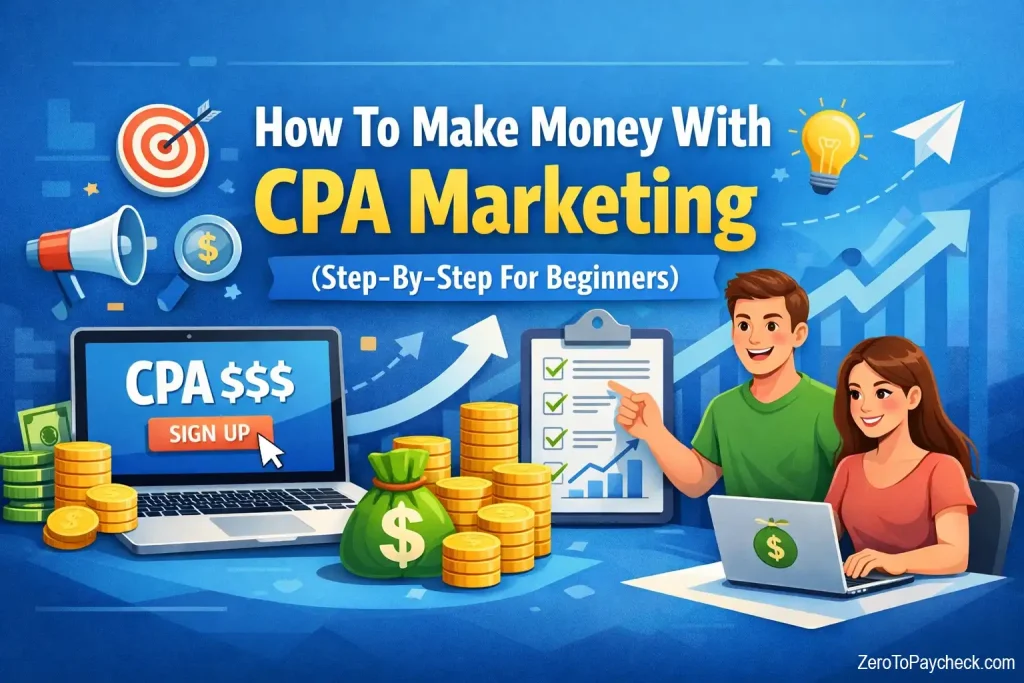
| Quick Definition: CPA (Cost Per Action) marketing is a performance-based model where you — the affiliate — earn a commission every time someone you refer completes a specific action. That action could be entering an email address, signing up for a free trial, filling out a lead form, or making a purchase. You don’t need to own a product. You don’t need to handle fulfillment. You just connect people to offers. |
Think of it like this. Imagine a wholesaler (the CPA network), a retailer (you, the affiliate), and a product (the offer). The advertiser — say, a home insurance company — needs leads. They don’t want to pay for clicks or impressions; they want to pay only when someone actually fills out their quote form. So they list their offer on a CPA network with a payout of $18 per qualified lead. Your job? Send people to that form who are genuinely interested in home insurance. Every time someone completes it, you get $18.
Simple concept. The execution is where skill comes in.
The beauty of this model is that you’re paid for performance, not potential. The advertiser only pays when they get what they want. And you only earn when your traffic does what it’s supposed to. It’s genuinely aligned incentives.
People often confuse these two. Here’s the key difference: traditional affiliate marketing (think Amazon Associates or most product-based programs) typically pays you a percentage of a sale. CPA marketing pays you for a much broader range of actions — many of which don’t require the visitor to spend any money at all.
That makes CPA, in many cases, easier to convert. Someone entering their email for a free quote has a much lower “commitment barrier” than someone pulling out their credit card to buy something.
| Factor | CPA Marketing | Traditional Affiliate |
| Paid When | Visitor completes an action (signup, lead, sale) | Visitor makes a purchase |
| Barrier to Entry | Low — no audience needed | Medium — content/audience helps |
| Learning Curve | Moderate (tracking, traffic) | Moderate (SEO, content) |
| Speed to First $ | Faster (days to weeks) | Slower (weeks to months) |
| Scalability | Very high with paid traffic | High with strong SEO |
| Upfront Cost | Low (free to start) | Low (hosting, content tools) |
| The global affiliate marketing industry is projected to reach $27.78 billion by 2027, according to research from Astute Analytica. Performance-based models — where advertisers pay only for results — are gaining share as brands demand better ROI from their marketing spend. For affiliates, this means more offers, better payouts, and a maturing ecosystem. |
Here’s the thing most beginner guides don’t tell you: the shift to performance-based advertising is actually accelerating. As cookies crumble (literally and figuratively — third-party cookie deprecation is reshaping digital advertising), advertisers are leaning harder into tracked, verifiable performance channels. CPA networks sit squarely in that space.
Data from the Performance Marketing Association suggests that affiliate and performance marketing now drives over 16% of all e-commerce sales in the United States. That’s not a niche. That’s a significant industry vertical with real budget behind it.
Let me be direct here, because I think it matters. CPA marketing is a good fit if:
It’s probably not for you if you want results in the first week with zero investment, you’re not willing to learn basic marketing concepts, or you’re looking for truly passive income with no ongoing effort. Those things don’t exist. And anyone who tells you they do is selling something.
The Contrarian Take: You Don’t Need an Audience
| Everyone says you need a massive blog or a huge social following to make money online. That’s simply not true with CPA marketing. You don’t need an audience — you need to understand how to direct targeted traffic to the right offer. Those are completely different skills. A 22-year-old with a $50 Facebook Ads budget and a well-researched audience targeting strategy can outperform a blogger with 100,000 monthly readers who hasn’t optimized for conversion. |
Not all CPA networks are created equal. I learned this the hard way early in my career — I applied to a network that had almost no online footprint, got approved immediately (red flag I ignored), and spent three weeks driving traffic to an offer. When I went to collect my first payout, the network had gone dark. No emails answered, no support ticket responses. About $340 gone, just like that.
That experience was a lousy lesson. But I’m passing it to you for free. Stick to established networks with verifiable payment histories and active affiliate communities.
Here are networks I’d actually recommend to a friend starting out:
| Network | Best For | Notes |
| MaxBounty | Beginners; wide offer variety | One of the most beginner-friendly; strong support |
| ClickDealer | Intermediate; global offers | Great variety, performance-focused team |
| Perform[cb] | Lead gen; finance/insurance | Premium offers, higher approval bar |
| CPAlead | App installs; content locking | Good for mobile traffic beginners |
| Admitad | E-commerce + retail CPA | Strong European and global offer inventory |
Getting approved is a hurdle for beginners. Most networks require a brief phone or Skype interview with an affiliate manager. Don’t let this intimidate you. Be honest about being new, but come prepared — know what niche you want to focus on, what traffic source you plan to use, and how much you can invest in testing. Affiliate managers aren’t trying to fail you; they want active affiliates generating volume. Show them you’ve done your homework and you’ll get in.
Pro tip: Apply to MaxBounty first. Their application process is beginner-friendly and their affiliate managers are genuinely helpful. I’ve spoken with affiliates who were approved within 48 hours of their first application just by being honest and demonstrating they’d actually read about the industry.
Good news: you don’t need much to start. Here’s the honest breakdown:
Essential (low or no cost):
Nice to have (once you’re generating revenue):
This is where I see beginners go wrong most often. They want to jump straight to the high-payout offers — the $80 insurance leads, the $200 product sales. I understand the logic. More money per conversion means less volume needed to profit. Right?
Wrong. At least at first.
What I’ve personally found is that starting with low-payout, high-volume offer types teaches you the fundamentals of the funnel much faster. Email submits and zip submits — where a user just enters their email or zip code — pay between $0.50 and $2.50, but they convert easily. That means you can run 500 visitors to an offer and actually get data back. You’ll see which ad creative works, which audience targeting converts, what time of day performs best. With a $40 sale offer, you might run 500 visitors and get zero conversions, with no idea why.
Start simple. Build your tracking muscles. Then graduate to higher-ticket offers.
Here’s a breakdown of CPA offer types to help you understand the landscape:
| Offer Type | Typical Payout | Difficulty | Best For |
| Email/Zip Submit | $0.50–$2.50 | Easy | Beginners — low friction, fast testing |
| Free Trial Offer | $10–$40 | Medium | Once you understand traffic quality |
| Lead Generation (CPL) | $3–$80 | Medium | Finance, insurance, home services niches |
| App Install | $1–$8 | Easy–Medium | Mobile traffic specialists |
| Product Sale (CPS) | $20–$200+ | Hard | Experienced affiliates with warm traffic |
| Beginner Tip: For your first offer, filter MaxBounty or ClickDealer by ‘Email Submit’ or ‘Zip Submit’ offers in categories like sweepstakes, finance, or lifestyle. Look for offers with an EPC (earnings per click) above $0.30 and solid creative support from the advertiser. Ask your affiliate manager which offers are converting well right now — they’ll tell you. |
Traffic is the engine of CPA marketing. Without it, nothing happens. And this is honestly where most of the skill lives.
There are two broad categories:
Free Traffic: Organic social media (TikTok, Facebook groups, Reddit), SEO-driven content, YouTube, email lists. Slower to build, but cost-effective long-term. A friend of mine built a consistent $2,000/month CPA income stream almost entirely through a niche Facebook group she cultivated over eight months. It took time, but her traffic costs were basically zero.
Paid Traffic: Google Ads, Meta (Facebook/Instagram) Ads, native advertising (Taboola, Outbrain), push notifications, pop traffic. Faster results, but requires testing budget. Most successful CPA affiliates work primarily with paid traffic because you can scale quickly once you find a winning combo.
My recommendation for beginners: pick one traffic source and stick with it for at least 60 days. The biggest mistake I see is hopping between sources. Facebook Ads today, Google Ads next week, TikTok the week after that. You end up learning none of them properly. Depth beats breadth when you’re starting out.
If you have some budget ($5–15/day), start with Facebook/Meta Ads for lifestyle offers or push notification networks for sweepstakes. If you have zero budget, build a content-driven Instagram or TikTok account in a niche aligned with your offers.
| Honest timeline: Most beginners don’t see their first real payout in week one or even week four. Give yourself 60–90 days to learn, test, and optimize. That’s not a slow timeline — that’s a realistic one. The affiliates who quit in week three are the ones you never hear about. The ones who stuck it out for 90 days? Many of them are still running campaigns profitably years later. |
Here’s where CPA marketing gets genuinely exciting. Once you have a campaign converting profitably — say you’re spending $30/day and generating $60/day in commissions — you scale. You increase the budget incrementally (20–30% at a time, not 10x overnight). You test new ad creatives. You expand the audience or geography. You take the landing page concept and test variations.
Veteran affiliates I’ve spoken with describe this phase as “optimization season.” It’s methodical work — tweaking, testing, scaling — but it’s the path from side hustle to real income.
You launch your first campaign. It doesn’t convert in week one. So you switch offers. Then switch networks. Then switch traffic sources. Then read about dropshipping and wonder if you should try that instead.
Stop. This is the #1 killer of beginners. Every profitable affiliate I know has a story of grinding through an early campaign that seemed dead — and then having it click once they stopped changing everything and started optimizing one variable at a time. Commit to one offer, one traffic source, one funnel for at least 30 days.
Running campaigns without a tracker like Voluum or RedTrack is like driving cross-country with no GPS and no map. You might eventually get somewhere, but you’ve wasted time and money on wrong turns you could have avoided.
Track everything: which ad creative generated the click, which keyword triggered the impression, what device the user was on, what time the conversion happened. This data is how you find the 20% of variables driving 80% of your conversions.
A $75 offer that converts at 0.2% is often less profitable than a $2 offer that converts at 8%. Do the math before you commit. And always consider the quality of the advertiser’s own landing page — you can’t control what happens after the click, but a terrible advertiser page will tank your conversion rate no matter how good your traffic is.
Every offer has terms of service — what traffic sources are allowed, what ad copy is permitted, which geographies are covered. Violate these and the network can reverse your commissions. Read the terms for every offer before you run it. This isn’t fine print; it’s your paycheck.
Red flags to watch for: no verifiable online history, no forum presence, immediate approval with no vetting, requests for fees to join, and offers that seem impossibly high-paying. Stick to established networks. Your commissions are only as secure as the network holding them.
I’m going to give you the real numbers here, because I think false expectations are genuinely harmful. They cause people to quit prematurely when they don’t hit $10,000 in month one, or to stay too long in a model that isn’t working for them.
| Timeframe | Realistic Income Range | What You’re Really Doing |
| Month 1–3 | $0–$200/month | Learning the mechanics, testing, likely breaking even or small loss on ad spend |
| Month 3–6 | $100–$1,000/month | Finding first profitable campaigns, building consistency |
| Month 6–12 | $500–$5,000/month | Scaling winners, testing new niches, system-building |
| Year 2+ | $2,000–$20,000+/month | Full campaign portfolio, possible outsourcing and automation |
It took me close to three months to see my first significant CPA payout — and that was after years of writing about this industry. Why? Because reading about it and actually running campaigns are genuinely different skills. The learning curve is real. Respect it.
DISCLAIMER: Results vary significantly based on your niche selection, traffic quality, testing budget, available time, and willingness to learn from data. These ranges are illustrative based on community-reported experience, not guarantees. CPA marketing income is also reportable as self-employment income — consult a tax professional about your obligations.
Not necessarily. Many offers allow direct linking, where you send traffic straight to the advertiser’s page via your affiliate link. However, a simple landing page almost always improves conversion rates. It lets you warm up cold traffic, pre-sell the offer, and filter out unqualified visitors. Think of it as a trust bridge between the ad and the offer. Carrd makes it genuinely easy to build one in under two hours.
Be honest and be prepared. Don’t claim experience you don’t have — affiliate managers can spot it instantly, and it kills trust before you start. Instead: know what niche you’re targeting, name the traffic source you’ll use, mention your testing budget (even $50/month shows you’re serious), and demonstrate you’ve done research. MaxBounty and CPAlead are particularly beginner-friendly. If you get declined, ask for feedback and reapply in 30 days.
Traditional affiliate marketing typically pays you a percentage of a sale (e.g., 5% of a $50 product = $2.50). CPA pays you for a completed action — which might be a sale, but more often is a lead, a signup, a form fill, or an app install. Because the required action is often lower-commitment than a purchase, CPA offers can convert more easily, especially for beginners who are still learning traffic quality.
Yes, though it’s slower. You can drive free traffic through organic social media (TikTok content in a relevant niche, Facebook group engagement, Reddit), SEO content if you have a blog, or an email list. Free traffic takes time to build but has better long-term economics once it’s established. Many successful affiliates started with zero ad budget and reinvested their first commissions into paid traffic once they had proof of concept.
Payment methods vary by network, but most established networks offer PayPal, Wise (formerly TransferWise), ACH bank transfer, and sometimes wire transfer or check. Payment schedules also vary — some networks pay weekly, others bi-weekly or monthly. Many have a minimum threshold (e.g., $100 before first payout). MaxBounty, for instance, pays weekly after the first month once you establish a track record. Always confirm payment terms before you start promoting.
Watch out for: no verifiable history or forum presence, immediate approval with no vetting process whatsoever, offers with payouts that seem 2–3x higher than competitors without explanation, networks that ask you to pay a fee to join, and poor or non-existent support channels. Do your homework. Check the network on affpaying.com, look for threads about them on STM Forum or AffLift, and Google “[Network Name] scam” or “[Network Name] not paying” before you commit time to their offers.
You can technically start with zero out-of-pocket cost using free landing page tools and organic traffic. A realistic beginner setup — domain, basic hosting or landing page tool, and a tracking account — runs about $30–$50/month. If you’re using paid traffic, budget at least $5–$10/day for testing, with the expectation that much of your early spend is education, not profit. Think of your first $200–$500 in ad spend as tuition for learning how campaigns actually work.
Here’s what I want you to take away from everything you just read.
CPA marketing is a real business model. It’s not passive income from day one, and it’s not a magic button that generates money while you sleep. It’s a performance-based skill — part marketing, part analytics, part psychology — that rewards people who learn systematically, test patiently, and iterate intelligently.
The barrier to entry is genuinely low. You don’t need a massive audience, a $10,000 budget, or years of marketing experience. What you do need is the willingness to treat this like a craft worth learning. The affiliates who fail are almost always those who expected results without the learning curve. The ones who succeed are the ones who treated every failed campaign as data, every conversion as confirmation, and every profitable day as a system worth building on.
You came to this guide probably a little skeptical. That’s healthy. Hold onto that skepticism — it’ll protect you from shady networks, too-good-to-be-true offers, and the endless parade of gurus who want to sell you shortcuts. But channel some of that same analytical energy into actually building something.
Start with research. Apply to MaxBounty or ClickDealer today. Have a conversation with an affiliate manager. Pick your first offer. Build a simple landing page. Drive your first 100 visitors. Learn from what happens. Then do it again, better.
Real, sustainable online income isn’t found. It’s built. And the framework to build it is right here.
| Your First Action Items Apply to MaxBounty or ClickDealer today (it takes 10 minutes)Set up a free Voluum or RedTrack trial accountBrowse STM Forum or AffLift for one hour to understand how affiliates thinkAsk your affiliate manager: ‘What email submit offers are converting well right now?’Build your first landing page. Keep it simple. Just start. |