Physical Address
304 North Cardinal St.
Dorchester Center, MA 02124
Physical Address
304 North Cardinal St.
Dorchester Center, MA 02124
You already know the feeling. You launch a Google Ads campaign, traffic spikes, leads trickle in—and the moment your budget runs dry, you’re invisible again. It’s like renting an apartment in a city you can never actually own property in. The moment you stop paying, you’re out.
Or maybe you’ve been grinding on Instagram, TikTok, or LinkedIn. Building an audience, playing the algorithm game—only to watch your reach collapse overnight because some platform decided to change the rules. Again.
Here’s what I’ve learned after two decades in digital media, building content sites from zero to millions of monthly visitors, surviving Google’s core updates (including a few that nearly gave me a heart attack), and—yes—making some expensive mistakes along the way: organic search traffic is the only channel that actually compounds. It’s an asset, not a rent payment.
But let me be straight with you: this isn’t fast. It’s not a hack, a loophole, or a shortcut. If you’re looking to triple your traffic in two weeks, close this tab. What I’m about to share is a systematic, durable strategy for building traffic that works harder the longer you stick with it.
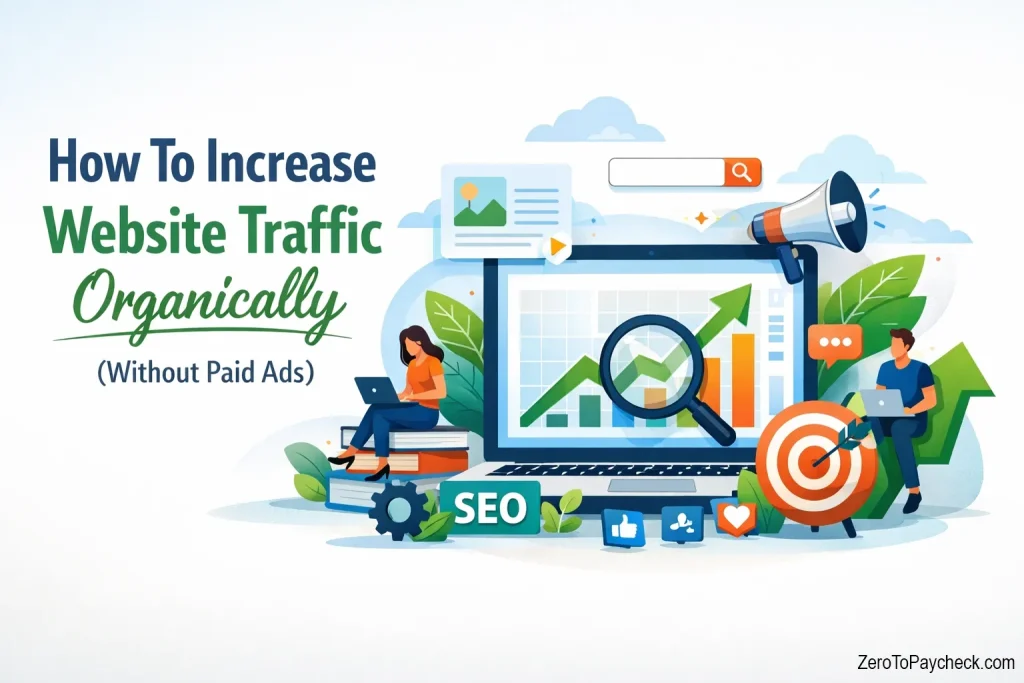
In this article, you’ll learn exactly how to increase website traffic organically—covering keyword research, content strategy, technical SEO, and legitimate authority building. Whether you just launched your site last month or you’ve been posting for two years and wondering why nothing’s moving, there’s something here for you.
| Quick Take: Organic search traffic is traffic that comes to your site through unpaid search engine results. When someone Googles a question and clicks your link—without you paying for that click—that’s organic traffic. It’s earned, not bought. |
Let me address the elephant in the room: SEO is harder than it was in 2015. If you’ve been in this game long enough, you remember when you could stuff keywords into a blog post, build a few mediocre backlinks, and watch the rankings roll in. That era is gone. Dead. Google’s algorithm has gotten scarily good at understanding context, intent, and quality.
But here’s the thing—everyone who says “SEO is dead” is wrong in exactly the way that benefits you. Because yes, the cheap tricks are dead. But legitimate, high-quality organic strategy? It’s more powerful than ever, precisely because so many people have given up on doing it right.
According to a 2024 study by Backlinko analyzing over 4 million search results, the #1 organic result on Google gets a 27.6% average click-through rate. The #2 result? Just 15.8%. And if you’re on page two? You’re essentially invisible. The difference between page one and page two isn’t just vanity—it’s the difference between a thriving business and a silent website.
Google rolled out its Helpful Content System in 2022 and has continued to evolve it. The signal is unmistakable: Google wants to reward content that’s genuinely helpful to humans, written by people with real experience. This is where the concept of E-E-A-T comes in—Experience, Expertise, Authoritativeness, and Trustworthiness. It’s not just a buzzword. It’s the lens through which Google evaluates whether your content deserves to rank.
Data from HubSpot’s 2024 State of Marketing report confirms that organic search generates 3.5x more traffic than paid search—and closes at a higher rate. Paid traffic stops the moment your credit card charge does. Organic traffic, once earned, keeps working.
So who is this strategy for? Honestly, it’s for bloggers who are tired of the content treadmill without results, small business owners who can’t compete dollar-for-dollar with enterprise PPC budgets, startup founders who need sustainable growth before Series A funding arrives, and content marketers who are done explaining to clients why last month’s paid campaign didn’t generate ROI.
Who is it NOT for? Anyone who needs leads in the next 30 days. Organic SEO requires a 6-12 month runway before you see meaningful traffic. That’s not a bug—it’s a feature. Because once you have it, it’s incredibly hard for competitors to take it away.
Every lasting organic traffic strategy rests on three interconnected pillars. Miss any one of them and the whole structure wobbles. Nail all three and you’ve built something that genuinely compounds over time.
| Keyword research is the process of identifying the specific words and phrases your target audience types into search engines. Getting this right is the difference between writing content that ranks and writing content that disappears into the void. |
Let me tell you something I learned the hard way from a niche gardening forum back in 2018. I’d been using tools like Ahrefs and Semrush to find keywords, which is absolutely the right call—but I was optimizing for search volume without understanding why people were searching. Then I stumbled into a forum thread where someone was ranting about their tomato plants wilting in August. They weren’t searching for ‘tomato plant care’—they were searching for ‘why do tomato leaves curl in heat.’ That single insight unlocked a content cluster that drove 40,000 monthly visits. Tools tell you what people search. Real conversations tell you why.
Here’s the framework that actually works:
Start with your audience’s problems, not with keywords. What are the three most common questions people ask you about your product, service, or niche? Those are your seed keywords. Then use Google’s autocomplete—start typing one of those questions and watch what Google suggests. Those suggestions are real searches from real people. That’s pure gold.
For example, if you type “how to increase website traffic” into Google, you’ll see suggestions like “how to increase website traffic organically,” “how to increase website traffic for free,” and “how to increase website traffic to my blog.” Each of those is a distinct keyword with a distinct user intent behind it.
Long-tail keywords are your fastest path to early wins. A keyword like “SEO” has hundreds of millions of search results and is dominated by giants like Moz, Semrush, and Google itself. But “keyword research for beginners with no budget”? That’s a long-tail keyword with manageable competition and a reader with a very specific need—someone you can actually help.
In my experience, chasing high-volume, broad keywords as a newer site is a waste of energy. Target long-tail keywords with under 1,000 monthly searches but clear intent. Win there first. Build your topical authority. Then the competitive terms start to follow naturally.
One contrarian take I’ll stand behind: you don’t need to publish daily to rank. I’ve watched dozens of site owners burn themselves out publishing five posts a week of mediocre content. Here’s what actually works: publish less, go deeper. One comprehensive, genuinely useful 3,000-word guide on a specific topic will outrank thirty 600-word posts every single time. Google’s algorithm is extraordinarily good at identifying thin content—and extraordinarily good at rewarding depth.
Topic clusters are the evolution of keyword research. Instead of targeting individual keywords, you build interconnected content networks. A pillar page covers a broad topic comprehensively. Cluster pages dive into specific subtopics and link back to the pillar. This signals topical authority to Google in a way that single, isolated blog posts never can. SEO leads I’ve managed report that the shift to topic clusters was their single biggest traffic win of the past two years.
| Technical SEO refers to optimizations that help search engines crawl, index, and understand your website. It’s the foundation everything else rests on—and it’s the area most content creators ignore until it’s a crisis. |
Okay, confession time. Here’s what surprised me more than almost anything in my career: a “boring” technical fix that nearly doubled a client’s traffic.
I was working with a B2B SaaS company whose content was genuinely excellent. Great writing, solid keyword research, decent backlinks. But their traffic was flatlined. We ran a technical audit and found something surprisingly mundane: their server response time was averaging 4.2 seconds. We moved them to a better hosting environment, implemented proper caching, and compressed their images. Within eight weeks, organic traffic was up 40%. Not because of a single new piece of content. Because Google could finally crawl their site efficiently and users weren’t bouncing.
Core Web Vitals are Google’s set of specific metrics that measure real-world user experience. The three main ones:
You can check your Core Web Vitals for free in Google Search Console—and you should. Right now. Go to the “Experience” section and look at your page experience data. If your pages are flagged as “Poor,” that’s actively suppressing your rankings.
Site architecture matters more than most people realize. Google has a crawl budget for each site—essentially a limit on how many pages it will crawl in a given period. If your site is structured poorly, with orphaned pages, broken internal links, or pages buried six clicks deep from your homepage, Google may never find your best content. A flat site structure where important pages are reachable within 2-3 clicks from the homepage is the goal.
Don’t overlook your XML sitemap and robots.txt file. Make sure you’re submitting an updated sitemap to Google Search Console. Make sure your robots.txt isn’t accidentally blocking important pages from being crawled (I’ve seen this happen more than once, usually after a developer makes changes they thought were minor).
Schema markup is the technical SEO secret weapon that most beginners haven’t discovered yet. By adding structured data to your pages, you help Google understand what your content is about—and unlock eligibility for rich results like featured snippets, star ratings, and FAQ accordions in the search results. These SERP features can dramatically increase your click-through rate even when you’re not in position one.
| Backlinks are links from other websites pointing to yours. Think of them like votes of confidence in a democratic election—the more reputable sources that vouch for you, the more authority Google assigns to your content. But like votes, not all of them count equally. |
Let me tell you about the worst SEO mistake I ever made. And I made it with complete confidence that I was being smart.
Back in 2016, I was running a content site in the personal finance space. I found a network of sites—what’s called a Private Blog Network, or PBN—that offered to sell me backlinks for $50 apiece. The sites looked legitimate. They had real content, decent domain authority scores, and the links came with anchor text I specified. Traffic climbed for about four months. Then Google’s Penguin algorithm update rolled through like a wrecking ball. Traffic dropped 70% overnight. It took 18 months to recover—if we ever fully did.
In my experience, link quantity is dead. But quality? It’s harder to get than ever. And it’s the only thing that actually moves the needle long-term.
Here’s what legitimate link building looks like in practice:
E-E-A-T goes beyond just backlinks. Google evaluates the author of your content. Do they have a real bio? Credentials? Social presence? External mentions? If you’re writing about financial planning, does your content reflect actual expertise—or is it generic advice that could have been assembled from a Wikipedia summary?
Add author bios to your content. Link to your professional profiles. Include your experience and credentials. If you’ve made mistakes in your niche, write about them—it’s more credible than presenting yourself as infallible. Real expertise is messy, and Google’s algorithm is getting better at detecting the difference.
You don’t need to spend a fortune to get started. Here’s what I actually use and recommend:
| Tool | Category | Cost | Best For |
| Google Search Console | Analytics & Indexing | Free | Tracking rankings, clicks, crawl errors |
| Google Analytics 4 | Traffic Analytics | Free | Understanding user behavior & traffic sources |
| Semrush | Full SEO Suite | $129/mo+ | Keyword research, competitor analysis, backlink audits |
| Ahrefs | Backlink & Keyword | $99/mo+ | Link building research, content gap analysis |
| Ubersuggest | Beginner SEO | Free / $29mo | Entry-level keyword research & site audits |
| Yoast SEO | On-page optimization | Free / $99/yr | WordPress on-page SEO optimization |
| Screaming Frog | Technical Crawling | Free (500 pages) | Finding technical SEO issues at scale |
| PageSpeed Insights | Core Web Vitals | Free | Checking LCP, CLS, INP scores |
Honestly, if you’re just starting out, Google Search Console plus Google Analytics is all you need for the first three to six months. Don’t let shiny tools distract you from the actual work. I’ve seen people spend more time in Semrush dashboards than writing content—and wonder why nothing’s growing.
Here’s the honest truth about timelines: SEO is not a sprint. It’s not even a marathon. It’s more like planting an orchard. You don’t plant trees and expect fruit in a week. But if you plant consistently and tend them well, you end up with something that produces fruit for years.
I’ve spoken with a publisher—let’s call her Sarah—who spent two years posting beautiful Pinterest-optimized content. Her visual strategy was smart, her design was excellent. But she’d never set up Google Search Console, had no idea what her Core Web Vitals looked like, and had a server response time of 6+ seconds. When she finally audited her site, she found 300 pages that weren’t even indexed. Two years of content, invisible to Google. Don’t be Sarah.
This is the most common mistake I see from people who’ve read half an SEO guide. They obsessively repeat their target keyword every 100 words, write clunky sentences that serve the keyword instead of the reader, and produce content that technically “checks the boxes” but that no human would ever want to read. Google has gotten extraordinarily good at detecting this. Write for humans. Optimize for search. In that order, always.
If someone offers to sell you 500 backlinks for $99, run. PBNs (Private Blog Networks), link farms, and bulk backlink schemes don’t just fail to work—they actively harm your domain rating and can get your site penalized or de-indexed entirely. I’ve been there. It’s a recoverable situation, but it’s painful and slow. There are no shortcuts to legitimate authority.
You might be reading this six months into your SEO journey and wondering why you’re not seeing results. Let me respond to the email I get version of this question every week: “I’ve been publishing for six months and my traffic is still under 500 visitors a month. Should I give up?”
No. Absolutely not. Months 1-6 are the “sandbox” phase—you’re building the foundation that will pay off later. Your impressions in Search Console should be growing even if clicks aren’t. Stick with it. The inflection point typically hits somewhere between months 6-12, and when it does, growth compounds quickly.
| Disclaimer: SEO results vary significantly based on your niche’s competitiveness, your site’s existing authority, the quality and consistency of your execution, and factors outside your control (like algorithm updates). No ethical SEO professional can guarantee specific traffic numbers or rankings. |
| Phase | Timeline | What’s Happening | What To Focus On |
| The Sandbox | Months 1-3 | Impressions growing, clicks minimal. Google is discovering & evaluating your content. | Content creation, technical setup, keyword research |
| The Traction | Months 3-6 | Some keywords begin appearing on pages 2-3. Early clicks trickle in. | Publishing cluster content, on-page optimization, first backlinks |
| The Inflection | Months 6-12 | Traffic begins compounding. Several posts ranking page 1. Clear topical authority emerging. | Scale content, aggressive link building, content updates |
| The Asset | Year 2+ | Organic traffic becomes a reliable, growing channel. New content ranks faster due to domain authority. | Maintain, expand to new topic clusters, monetize efficiently |
Here’s the honest benchmark: a brand-new site in a moderate competition niche, executing this strategy consistently, can realistically expect 5,000-15,000 monthly organic visitors within 12-18 months. Existing sites with some authority can move faster. Highly competitive niches (finance, health, legal) take longer and require more investment in E-E-A-T signals.
| Quick Answer: Most sites see meaningful traffic growth between 6-12 months with consistent execution. New sites typically spend the first 3 months building infrastructure with minimal visible results—this is normal and expected. |
Not directly. Social media shares don’t factor into Google’s ranking algorithm as a direct signal. But indirectly? Yes. Good content that gets shared socially earns exposure, which leads to more natural backlinks, more branded searches, and more direct traffic signals—all of which do matter. Think of social media as amplification, not ranking juice.
This is the wrong question. The right question is: are the posts you’re publishing genuinely better and more comprehensive than what currently ranks? Publish 20 outstanding posts on tightly related topics and you’ll outperform someone who published 200 mediocre ones. Topical authority and depth beat volume every time.
Google’s official position is that it doesn’t penalize AI-generated content per se—it penalizes low-quality, unhelpful content regardless of how it was produced. That said, I’m genuinely skeptical of AI content farms that produce hundreds of thin articles. The sites I’m watching that are growing in 2024 use AI as a productivity tool—for research, outlines, first drafts—then add substantial human expertise, experience, and editing. Pure AI output, published at scale without human editorial oversight? That’s a race to the bottom. The Helpful Content System was specifically designed to catch it.
A featured snippet is the box that appears at the top of Google search results—above the standard organic listings—that directly answers a query. It’s sometimes called “Position Zero.” To target one: identify questions your content answers, structure your answer clearly and concisely (40-60 words is the sweet spot), use headers to organize your content, and use lists or tables where appropriate. The thrill of seeing your content in a featured snippet for the first time—honestly, it never gets old.
Yes. Great content is necessary but not sufficient. Think of content as your argument and backlinks as the evidence that other people find your argument credible. In competitive niches, excellent content without backlinks will still struggle to outrank mediocre content with strong link profiles. You need both. The good news: genuinely great content earns backlinks more naturally than average content, so the two pillars reinforce each other.
Domain Authority (DA) is a metric developed by Moz (and similar metrics exist in Ahrefs, called Domain Rating or DR, and Semrush, called Authority Score) that predicts how well a site is likely to rank based on the quality and quantity of its backlinks. It ranges from 1-100. You improve it by earning high-quality backlinks from authoritative sites—the strategies covered in Pillar 3 above. Don’t obsess over the number itself; focus on the underlying actions that move it.
Crawl budget refers to the number of pages Googlebot will crawl on your site within a given time frame. For small sites under a few hundred pages, it’s rarely a pressing concern. But as you scale to thousands of pages, it matters. Make sure you’re not wasting crawl budget on low-value pages—pagination, filtered category pages, internal search result pages—by using robots.txt to prevent Googlebot from crawling them.
We started this conversation with a simple frustration: you’re tired of paying for traffic that disappears the moment you stop paying. You want something that lasts.
Here’s the truth I’ve arrived at after twenty years in this game: organic search is the closest thing to a permanent asset in digital marketing. A blog post that earns page-one rankings doesn’t stop sending you traffic on the weekends. It doesn’t charge you more when competition increases. It compounds.
But it requires something most marketers aren’t willing to give it: patience. Real, sustained, month-after-month patience combined with consistent, high-quality execution.
The strategy is straightforward. Research what people actually search for. Create content that’s genuinely better than what exists. Make sure Google can find and understand it. Build real authority through legitimate means. Then wait. And keep working while you wait.
The sites I’ve watched grow from zero to sustainable six-figure traffic all share one thing: they didn’t quit during the sandbox phase. They kept publishing when the data looked bleak. They kept building when the results were invisible. And then—usually somewhere around month 9 or 10—the inflection point hit, and everything changed.
Don’t let that be the month you decided to give up.
| Your next step: Open Google Search Console right now. Check your Core Web Vitals report. Look at your Performance tab and find one keyword where you’re ranking positions 11-20. That’s your first optimization target. Go write something better than what’s currently on page one. |
The traffic is there. The search volume is real. The questions are being asked every single day. The only question is whether your site shows up with the answer.
Related Reading: