Physical Address
304 North Cardinal St.
Dorchester Center, MA 02124
Physical Address
304 North Cardinal St.
Dorchester Center, MA 02124
A Beginner’s Guide — From Zero to Your First Real Win
Let’s skip the hype.
You’ve already seen the headlines. “Make $10,000 a month blogging from your laptop on a beach!” You’ve probably rolled your eyes — and honestly, you should. That kind of promise has burned a lot of people. Maybe including you.
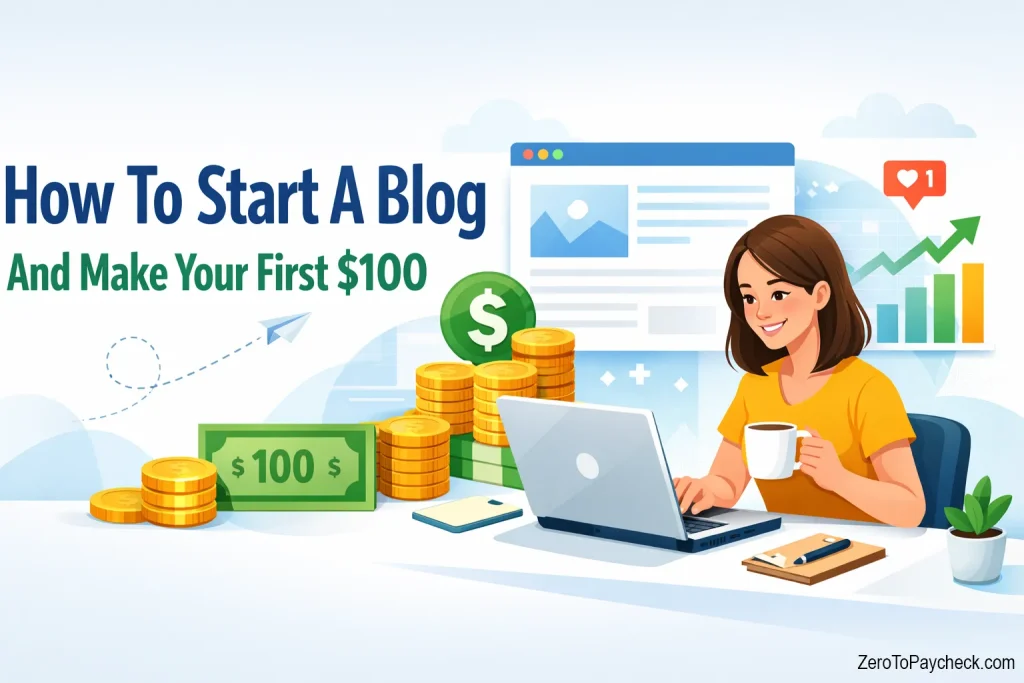
But here’s what nobody’s saying clearly enough: you don’t need $10,000. You just need $100. That first hundred dollars is the only thing that matters right now — because it proves something real. It proves the model works. It proves your effort translates to actual money. And once you see that, everything changes.
I’m not going to tell you blogging is easy. It isn’t. But it’s also not the technical nightmare most beginners imagine. And the path to your first $100 is shorter than you think — if you stop doing what everyone else tells you to do and focus on what actually works in the early days.
In this guide, you’ll learn exactly how to set up a blog without losing your mind, choose a niche that can actually make money, write the minimum content you need to get started, and earn your first $100 through the fastest legitimate route available. That’s the goal. Let’s get there.
| Quick Takeaway The first $100 from a blog isn’t just money — it’s proof of concept. It’s your brain realizing this is real, and that’s what makes everything after it easier. Don’t skip this milestone chasing bigger numbers. |
Here’s the thing about the creator economy right now: according to a 2023 report by Linktree, there are over 200 million people who consider themselves content creators. That sounds like too much competition. But the vast majority of them quit before month three. Why? Because they set the bar too high, saw nothing happening, and walked away.
The $100 milestone is psychological as much as financial. It rewires your brain. Once money has actually moved from a stranger’s account to yours — because of words you wrote — blogging stops being an abstract fantasy and becomes a repeatable skill. That shift matters enormously.
I know a teacher in Ohio who started a blog about classroom management in 2021. She wasn’t a writer. She wasn’t technical. She wrote six posts in her first two months. By month three she had made $94 from a single affiliate link inside one of those posts. She told me later: “That $94 changed everything. I finally believed it was real.” She now earns enough from that blog to cover her car payment every month. No viral posts. No massive audience. Just the right niche, honest content, and showing up consistently.
Who is this for? Honestly, anyone willing to do the actual work. But it’s especially well-suited for people who have specific knowledge about anything — teaching, cooking, parenting, fitness, finance, tech, crafts, travel on a budget. You don’t need to be famous. You need to be useful.
Who is it NOT for? People expecting passive income in week one. People who want to set it up and forget it. People who aren’t willing to write at least a few hundred words a week for the first few months. This is a real business. It just has a low barrier to entry.
This isn’t about building a perfect blog. It’s about building a profitable one. Those are very different things — and most beginner guides confuse them. Your blog isn’t a house you build before opening the doors. It’s more like a lemonade stand. Set it up fast, sell a cup, then build the patio.
You need three things to start a blog: a domain name, hosting, and WordPress. That’s it. Everything else — premium themes, fancy plugins, custom logos — is optional and can wait until you’ve made money.
Domain name: This is your blog’s address (like yourblog.com). It costs around $12–15 per year. Get it from Namecheap or GoDaddy. Keep it short, memorable, and relevant to your niche. Here’s something nobody tells beginners: your domain name matters psychologically, not just for SEO. A domain that clearly signals what the blog is about — like BudgetMealPrep.com vs. SarahsCookingCorner.com — tells a visitor in 0.5 seconds whether they’re in the right place. That split second can make or break your bounce rate.
Web hosting: This is the server where your site lives. For beginners, Bluehost or SiteGround are both solid starting options. Bluehost’s basic plan runs about $2.95/month on introductory pricing (renews higher — read the fine print). SiteGround costs a little more but has better customer support, which matters when you’re new.
WordPress.org (not WordPress.com): This distinction trips up so many beginners. WordPress.com is a free hosted platform that limits what you can do and how you can monetize. WordPress.org is the self-hosted, free software you install on your hosting account that gives you full control. Always use WordPress.org.
| Feature | WordPress.com (Free) | WordPress.org (Self-Hosted) |
| Cost | Free (but limited) | ~$3–10/month for hosting |
| Custom domain | Paid upgrade needed | Yes, fully yours |
| Monetization | Restricted | Full control |
| Plugin access | Very limited | 50,000+ plugins |
| SEO control | Minimal | Complete |
| Recommended for profit? | No | Yes |
Once you have hosting and WordPress installed (most hosts offer a one-click install), pick a free theme like Kadence or Astra. Don’t spend a week on this. Pick one. Move on.
I spent my first three months obsessing over my blog’s logo. I tried three different themes. I redesigned my about page twice. I made $0. Don’t do that.
Your niche is far more important than your design. And here’s where most people go wrong: they pick something too broad. “Lifestyle” blog. “Travel” blog. “Health and wellness” blog. These sound great but they’re invisible in search results because the competition is enormous and your topic authority is zero.
What works? Specificity. Instead of “fitness,” try “strength training for women over 40.” Instead of “cooking,” try “30-minute dinners for picky eaters.” Instead of “personal finance,” try “debt payoff strategies on a teacher’s salary.”
The rule of thumb I use: if you can add a specific person and a specific problem to your niche description, you’ve got something workable. “X for Y who struggle with Z.” That structure forces the kind of precision that actually helps you rank.
Before you commit, do one simple check: go to Google and search for your niche topic plus the word “blog.” If you see established blogs in the first few results with years of content, that’s actually a good sign — it means there’s an audience. Your job isn’t to beat them immediately. It’s to serve a slightly more specific slice of that same audience.
You do not need 50 blog posts to make your first $100. You need three really good ones.
A pillar post is a comprehensive, genuinely helpful article on a core topic in your niche. Think 1,500 to 2,500 words. Not padded. Not stuffed with keywords. Actually useful to someone who found it with a specific question.
Here’s how to structure your first three posts:
For keyword research, use Keysearch (about $17/month) or the free version of Ubersuggest. You’re looking for keywords with some search volume (200+ monthly searches) and low-to-medium competition. Don’t chase high-volume keywords at the start — you won’t rank for them. Find the longer-tail, more specific ones.
There are a lot of ways to make money blogging. But for your first $100, you want the fastest path. Here’s what that looks like, in order of speed:
I’ll be honest: affiliate marketing sounded like a scam to me at first. “Just recommend products and get paid?” It felt suspicious. But after understanding that it’s essentially the digital version of word-of-mouth referrals — something humans have done forever — I realized it’s just recommending tools you actually use, and getting credited when that recommendation leads to a sale. Amazon Associates is the easiest starting point (though commissions are low at 1–4%). ShareASale and Impact host programs with much better commission rates, often 20–50% on digital products.
The goal is simple: your Product Recommendation post (Post 2 above) should contain at least one affiliate link to a product you’d genuinely recommend to a friend. If even 2–3 people click and buy through a program with a decent commission rate, you’re looking at your first $50–100.
| Quick Takeaway You don’t need to spend a fortune to start a profitable blog. Most of the tools beginners agonize over are optional. This list covers everything you genuinely need to get started and nothing you don’t. |
Must-Haves:
Recommended Upgrades (Once You’re Earning):
What you absolutely do not need right now: a premium theme ($50–$200), a professional logo design, a course about blogging (most of what you need is available free), paid social media schedulers, or an email marketing tool beyond ConvertKit’s free tier.
Week 1 — Setup & Niche Lock-In:
Weeks 2–3 — Content & Monetization Setup:
Month 1 — The Contrarian Traffic Play:
Here’s where I’m going to tell you something that conflicts with most beginner blogging advice, and I want you to take it seriously.
Everyone tells you to focus on Google SEO first. That’s a mistake for a brand-new blog. SEO takes months — sometimes 6 to 12 months — before Google starts sending you meaningful traffic. If you’re waiting on organic search to make your first $100, you could be waiting a very long time.
Instead, go where your audience already is. Right now. This week.
This approach won’t make you famous. It doesn’t need to. It just needs to get 100–200 targeted visitors to your Product Recommendation post. With a decent affiliate offer and even a modest 2–3% conversion rate, that’s your first $100.
This is the most expensive mistake in blogging, and it costs you something worse than money — it costs you time. I’ve watched people spend six weeks building “the perfect blog” before publishing a single post. They tweaked their fonts. They agonized over color palettes. They wrote and rewrote their About page.
They made $0. Because no one was there to read anything.
Your blog does not need to be beautiful. It needs to be useful. Publish ugly. Improve later. The posts are the product. Everything else is packaging.
A blog with no readers is a diary. The moment you publish your first post, start building an email list — even if it’s tiny. ConvertKit’s free plan lets you collect subscribers and send emails to up to 1,000 people. Add a simple opt-in to your site (“Get my free [niche-relevant] checklist”) from day one.
Here’s what surprised me when I first tested this: a list of even 50 engaged subscribers is worth more than 5,000 random visitors. These are people who trusted you enough to give you their email address. When you eventually launch a product or have a recommendation, they’re the ones who buy.
I can already hear someone asking: “Can’t I just put affiliate links in every post from day one?” You can. But you probably won’t make much. Here’s the deal — people buy from people they trust. Three posts isn’t a lot of trust to build. But if those three posts are genuinely helpful and clearly written by someone who knows their stuff, that’s enough to earn a recommendation.
The key is to lead with value every time. Solve the problem first. Then, naturally, mention the tool or product that helps solve it even faster. That’s the difference between a blog that converts and one that just exists.
Picking a niche just because it’s “profitable” is a trap. The most lucrative niches — finance, health, legal — are also the most competitive and the most heavily scrutinized by Google (these fall under what Google calls “Your Money or Your Life” categories, or YMYL). Unless you have genuine credentials or extensive experience in those areas, you’ll struggle to rank and struggle to establish authority.
Pick something you know. Or something you’re actively learning and willing to document transparently. “My journey learning to invest as a 32-year-old with no background” is a valid angle. It’s honest. It’s relatable. And it builds trust in a way that cookie-cutter finance advice simply doesn’t.
| Quick Answer: How Long to Make Your First $100 Blogging? Honestly? Most beginners who follow a focused strategy see their first $100 between months 2 and 6. Some get there faster with a high-commission affiliate product and targeted traffic. Some take longer. Variables include niche competitiveness, content quality, consistency, and which traffic source you leverage. Results vary — and anyone claiming otherwise is selling something. |
Let’s be specific about timelines, because vague advice drives me crazy.
Month 1–2:
Likely income: $0–$20. You’re building the foundation. Don’t panic. This is normal. Your focus is on setup, content, and getting your first 50–200 visitors through Pinterest or Reddit.
Month 3–4:
Likely income: $20–$100. If you’ve published your 3 pillar posts, set up at least one affiliate program, and driven targeted traffic to your recommendation post, you’re in striking distance of that first $100. Some people hit it here. Some take a bit longer.
Month 5–6:
Likely income: $100–$500. By now, Google is starting to notice you. You may be getting some organic traffic. Your Pinterest presence is growing. You’ve likely hit $100 and you’re starting to think about scaling — more posts, more affiliate programs, maybe a simple digital product.
What affects this timeline? Niche selection (specific niches convert faster), the quality of your product recommendations (higher-ticket items with higher commissions), how consistently you publish, and — critically — which traffic sources you pursue early.
One important note: even $100 from a blog is reportable income. Keep records. Talk to an accountant if you start earning regularly. Most countries require reporting freelance or business income above a minimum threshold, and blogging income is no different. Track it from the start, even when it feels small.
No. You need to be helpful. Big difference. Good writing is polished prose with perfectly constructed sentences. Helpful writing is explaining something clearly so that the reader can act on it. Most successful bloggers aren’t elegant stylists — they’re clear communicators. If you can explain something to a friend over text, you can blog. Write like you talk. Edit out the awkward parts. That’s it.
You might be wondering this. And yes, there are more blogs now than ever. But here’s the counterintuitive truth: there’s also more search volume than ever, more affiliate programs, more products, and more people looking for niche expertise than at any previous point. The blogs that are failing are the generic ones. The ones winning are the specific, authoritative, genuinely helpful ones. That gap is an opportunity, not a closed door.
Start by making a list of 10 things you know better than the average person. These don’t have to be impressive. They can be practical: how to get your kid to eat vegetables, how to manage anxiety without medication, how to fix common car problems yourself, how to negotiate a lease. Pick the one you could talk about for an hour without notes. That’s your starting niche. You can refine it as you go.
Nope. Plenty of profitable blogs are entirely anonymous or faceless. What matters is that your content establishes expertise and builds trust. An author bio that says “Sarah, a certified nutritionist with 10 years of clinical experience” builds trust. So does “A former ICU nurse writing about practical health for real families.” You don’t need a photo. You need credibility signals — credentials, specific experience, transparent methods.
Your real minimum to start: domain (~$12/year) plus hosting (~$35–50 for your first year on a basic plan). Call it under $70 total to have a real, monetizable blog with your own domain and full WordPress control. Everything else — themes, tools, plugins — can wait until you’re earning. In my experience, the best investment for a new blogger isn’t tools. It’s time spent on content.
Run. Seriously. No legitimate blogging course makes that promise because no legitimate educator would make it. The bloggers selling $997 “make money fast” courses are, in most cases, making their money selling the course — not from the blogging method they’re teaching. The real path is slower, less glamorous, and far more reliable. Spend your $997 on a year of hosting and a keyword tool. You’ll come out ahead.
Here’s the honest truth I wish someone had told me at the beginning: blogging isn’t a hack. It’s a skill. And like any skill — cooking, coding, playing an instrument — the first few months are the hardest because you’re building the foundation. The returns feel invisible. Then, suddenly, they compound.
What I’ve personally found is that the people who make it in blogging aren’t necessarily the best writers, the most knowledgeable in their niche, or the most technically savvy. They’re the ones who show up consistently after the initial excitement wears off. They publish when they don’t feel inspired. They tweak and improve. They treat it like a business.
You don’t need luck. You need clarity and consistency. The clarity to pick a specific niche and a specific audience. The consistency to publish real, useful content on a regular schedule and promote it in places where your audience already gathers.
The $100 milestone is not the end goal — it’s the proof of concept that makes everything else believable. Once you’ve earned it, you’ll know this works. And knowing is half the battle.
Your next step is simple: Go buy your domain today. Choose your niche. Set up WordPress this weekend. Write your first pillar post. That’s the only thing standing between you and your first $100.
| Also read: • How to do keyword research for a new blog (beginner guide) • Affiliate marketing for beginners: how to pick the right programs • How to write your first blog post (even if you’re not a writer) • Best free WordPress themes for new bloggers • How to use Pinterest to drive traffic to a brand-new blog • ConvertKit vs Mailchimp: which email tool is right for beginners? • How to create a simple digital product and sell it on your blog • Blog niche selection: the complete guide to finding your focus |
Disclaimer:- Results from blogging vary based on niche, consistency, traffic strategy, and time invested. The income ranges cited in this guide reflect common beginner experiences but are not guaranteed. Treat your blog as a business, not a lottery ticket.